
The system boundary changes the calculation
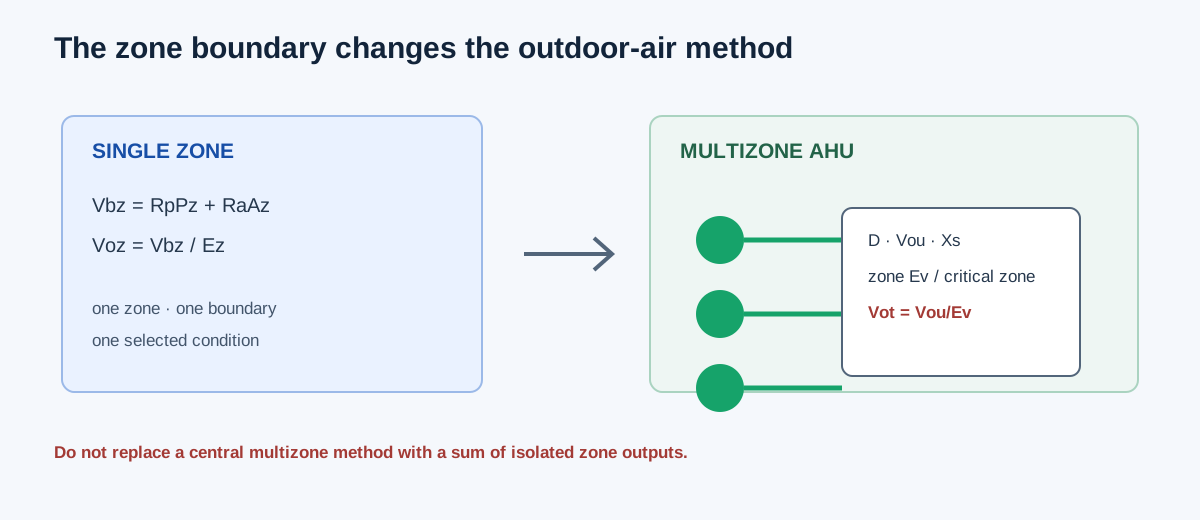
A single-zone calculation answers how much outdoor air one zone needs from its people rate, area rate, and distribution effectiveness. A central multizone air handler must also account for concurrent system population, primary airflow, zone minimum primary flows, and the critical ventilation efficiency.
The site keeps three multizone profiles separate: historical Appendix single-supply, historical Appendix secondary-air, and the 2019 simplified minimum-flow branch. These are calculation profiles with explicit inputs; the page does not choose current standard rates or claim jurisdictional compliance.
| Method | Needs | Output |
|---|---|---|
| Single zone | Rp, Ra, Pz, Az, Ez | Vbz and Voz |
| Multizone single supply | Zone rates, populations, areas, Ez, Vpz, Ps, Vps | Vou, Ev, critical zone, Vot |
| Multizone secondary | Single-supply inputs plus Vdz and characterized Er | Secondary-air efficiency and Vot |
| Simplified branch | Zone rows, diversity, primary minima | Simplified Ev, Vot, minimum-flow feasibility |
Enter one source basis and one coincident scenario
For single-zone mode, enter the rate table values from the selected edition and occupancy category, zone population, floor area, and actual distribution effectiveness. For compare mode, use the same population and area for both scenarios and enter each scenario’s rates and effectiveness.
For multizone mode, enter a concurrent system population and one analyzed AHU primary airflow. Zone minimum primary flows must belong to the same condition. Secondary-air mode requires independently characterized Er; it is not the arithmetic fraction of secondary flow.
| Step | Check |
|---|---|
| 1 | Choose the documented equation profile |
| 2 | Enter Rp/Ra/Ez and zone population/area |
| 3 | Set concurrent system population and primary flow |
| 4 | Enter every zone row and secondary data if applicable |
| 5 | Review critical efficiency, intake fraction, and feasibility |
Independent single-zone example
Use one zone with Pz = 20 people, Az = 2,000 ft², Rp = 5 CFM/person, Ra = 0.06 CFM/ft², and Ez = 1.0. People component is 5×20 = 100 CFM; area component is 0.06×2,000 = 120 CFM. Vbz = 220 CFM and Voz = 220/1 = 220 CFM.
For a comparison scenario with Rp₂ = 7.5, Ra₂ = 0.05, and Ez₂ = 0.8, Vbz₂ = 150 + 100 = 250 CFM and Voz₂ = 250/0.8 = 312.5 CFM. The increase is 92.5 CFM, or 42.045455%.
Vbz = RpPz + RaAz
Voz = Vbz/Ez
Scenario 1: 5×20 + 0.06×2,000 = 220 CFM
Scenario 2: 7.5×20 + 0.05×2,000 = 250 CFM
Voz₂−Voz₁ = 312.5−220 = 92.5 CFM
| Result | Independent value | Calculator display |
|---|---|---|
| Scenario 1 Vbz/Voz | 220 / 220 CFM | 220 / 220 CFM |
| Scenario 2 Vbz/Voz | 250 / 312.5 CFM | 250 / 312.5 CFM |
| Scenario difference | 92.5 CFM | 92.5 CFM |
| Percentage difference | 42.045455% | 42.045455% |
Independent multizone example
Use three zones, system population 24 of 30, system primary flow 900 CFM, and rows (5, .06, 10, 1000, 1, 300), (5, .06, 20, 2000, .8, 500), and (5, .06, 0, 500, 1, 100). Undiversified people component is 5×24 = 120 CFM after the system diversity factor D = 24/30 = .8 is applied to the total people term of 150 CFM; area component is 210 CFM. Vou = 330 CFM.
Zone 2 has Voz = (5×20 + .06×2,000)/.8 = 275 CFM. Its single-supply efficiency is Ev = 1 + 330/900 − 275/500 = 49/60 = .816666667. Required intake is Vot = 330/(49/60) = 404.081633 CFM. The sum of individual zone Voz values is 415 CFM, which is a different quantity.
D = Ps/ΣPz = 24/30 = 0.8
Vou = DΣ(RpPz) + Σ(RaAz) = 0.8×150 + 210 = 330 CFM
Ev,2 = 1 + Xs − Zpz = 1 + 330/900 − 275/500 = 49/60
Vot = 330/(49/60) = 404.081633 CFM
| Result | Independent value | Calculator display |
|---|---|---|
| Population diversity | 0.8 | 0.8 |
| Uncorrected intake Vou | 330 CFM | 330 CFM |
| Critical zone | Zone 2 | Zone 2 |
| System efficiency | 0.816666667 | 0.816666667 |
| Required intake | 404.081633 CFM | 404.081633 CFM |
| Sum of zone Voz | 415 CFM | 415 CFM |
Interpret feasibility and critical zones
A critical zone is the zone with the lowest calculated efficiency under the selected method. A positive intake fraction or a feasible flag does not override an invalid efficiency, an intake larger than primary flow, or an unmet simplified minimum primary flow.
Do not mix cooling and heating scenarios, alternative occupancy peaks, density bases, or single-zone results into one total without a documented design method. Carry the selected rates, effectiveness, population diversity, and primary-flow condition into the next ventilation and air-balance review.
| Finding | Next check |
|---|---|
| Critical zone | Verify zone rate, Ez, Vpz, and coincident condition |
| Secondary-air mode | Document Er and actual topology |
| Simplified minimum failure | Increase/revisit primary flow or mark infeasible |
| Intake > primary | Check flow basis and design condition; do not clip |
| Single-zone result | Use only for that zone boundary |
FAQs
Can I add every zone Voz to get AHU intake? Not for the Appendix multizone method. The critical-zone efficiency and system diversity are part of the central calculation. Can I infer Er from Vdz and Vpz? No. Er is a characterized secondary-air factor. Does a selected rate prove the current standard? No; rates and applicability are user inputs.
The calculators do not select occupancy tables, demand-control schedules, local exhaust/makeup-air credits, current adopted editions, weather, or code compliance. They preserve infeasible or unsupported results.
Conclusion and limits
Use single-zone equations for one zone, and use a multizone method when the central AHU and zone primary flows interact. Keep the critical zone, system efficiency, diversity, and feasibility visible instead of replacing them with a sum of isolated zone numbers.
The cited ASHRAE equation profiles support the implemented relationships and historical boundaries. They do not select current rates or establish a complete adopted-standard design.