
A flow deficit is different from a pressure prediction
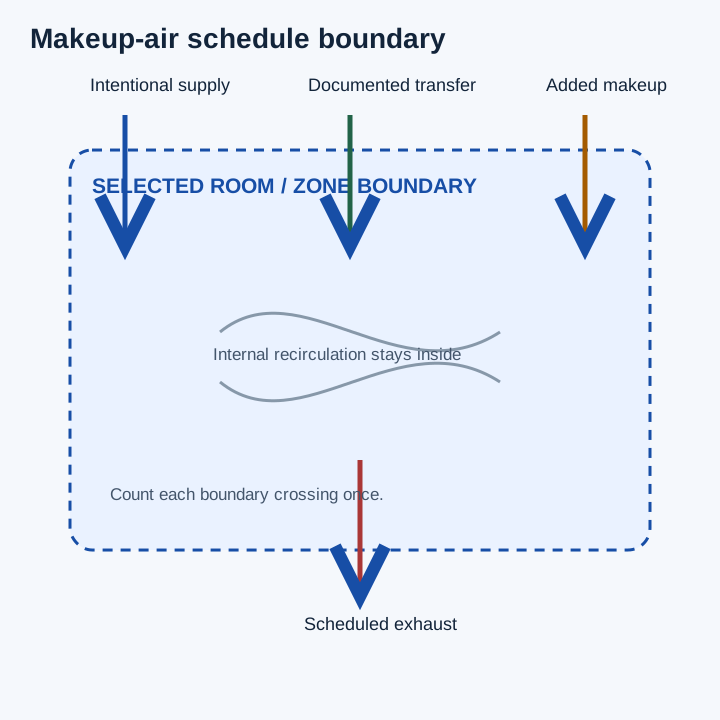
A makeup-air calculation accounts for air crossing a chosen boundary. Scheduled exhaust leaves that boundary; intentional supply, documented incoming transfer, and added makeup air enter it. A flow schedule can identify a deficit. It cannot by itself determine the pressure difference that will drive air through the building envelope or an interior opening.
Pressure also depends on resistance, leakage paths, fan characteristics, controls, and other operating conditions. Equal scheduled flows do not prove neutral building pressure. A positive incoming-flow target is likewise a flow objective, not a pressure setpoint.
| Method | Use when | Required result basis |
|---|---|---|
| Volume-flow balance | All entered flows use a compatible air-density basis | CFM on that common basis |
| Actual-density mass balance | Actual flows are at different states/densities | Added CFM at the specified makeup-air density |
| Building-pressure analysis | The question is a room/building pressure difference | Separate leakage, resistance, fan and control evidence |
Define the boundary and simultaneous operation
Choose whether the schedule concerns a room, dwelling, or another explicitly defined zone. List the exhausts operating simultaneously and the intentional incoming streams for that same condition. Air transferred from an adjacent room crosses a room boundary, but the same air may not cross the exterior boundary of the whole building. Changing the boundary changes the schedule.
Do not credit supply recirculating entirely inside the selected boundary as outside replacement air. Do not credit an assumed door gap or uncontrolled infiltration as a documented transfer flow. If the relevant paths or operating conditions are unknown, obtain them rather than using the calculator to fill the gap.
- Volume mode: enter Total scheduled exhaust, Existing intentional supply, Explicitly allowed incoming transfer, and Selected supply surplus target, all as nonnegative CFM.
- Mass mode: enter each actual exhaust, supply, and incoming transfer CFM with its own positive total-air density in lbm/ft³.
- Also enter the proposed makeup-air total density and a nonnegative selected mass-surplus target in lbm/h.
- Document the density sources and common boundary, then confirm the mass-balance basis. A reference note records assumptions; the calculator cannot authenticate it.
Equations and units for the two methods
Volume mode subtracts existing intentional supply and allowed incoming transfer from exhaust plus the selected surplus target. A negative deficit means no additional incoming air is required by this arithmetic; the tool reports zero added makeup and a surplus instead of a negative makeup flow.
Mass mode converts each actual stream to total-air mass per hour, subtracts the incoming mass from exhaust plus the selected target, and divides the remaining mass deficit by the proposed makeup density. Total-air density includes water vapor where present. Do not substitute dry-air density or an unspecified SCFM value.
Volume: Qadded = max(0, Qexhaust + Starget − Qsupply − Qtransfer)
Each actual stream: ṁ = 60 × Qactual × ρtotal
Mass deficit: ṁadded = max(0, ṁexhaust + Ṡtarget − ṁsupply − ṁtransfer)
Required makeup volume: Qadded = ṁadded / (60 × ρmakeup)
| Quantity | Meaning | Unit |
|---|---|---|
| Qactual | Volume at the corresponding stream’s actual state | ACFM |
| ρtotal | Total air mass per actual stream volume | lbm/ft³ |
| ṁ | Total-air mass flow | lbm/h |
| Starget or Ṡtarget | Selected incoming surplus objective | CFM or lbm/h, according to mode |
| ρmakeup | Total density at the proposed makeup state | lbm/ft³ |
Independent volume and mass examples
Volume example: enter 600 CFM scheduled exhaust, 100 CFM intentional supply, 50 CFM incoming transfer, and zero selected surplus. On the assumed compatible density basis, added makeup = 600 − 100 − 50 = 450 CFM. This reproduces the volume-mode example.
For the separate constructed mass example, use 600 ACFM exhaust at 0.075 lbm/ft³, 100 ACFM supply at 0.070, and 50 ACFM transfer at 0.080. Exhaust mass = 60 × 600 × 0.075 = 2,700 lbm/h. Supply mass = 420 lbm/h and transfer mass = 240 lbm/h. With zero mass-surplus target, the deficit is 2,700 − 420 − 240 = 2,040 lbm/h.
At the entered makeup density of 0.065 lbm/ft³, required makeup volume = 2,040 / (60 × 0.065) = 523.076923 ACFM, displayed as 523.077 CFM at makeup density. This independently matches the mass-mode example. The density values are constructed teaching inputs, not standard defaults or product recommendations.
| Stream | Actual volume | Total-air density | Mass flow |
|---|---|---|---|
| Exhaust leaving | 600 ACFM | 0.075 lbm/ft³ | 2,700 lbm/h |
| Intentional supply entering | 100 ACFM | 0.070 lbm/ft³ | 420 lbm/h |
| Transfer entering | 50 ACFM | 0.080 lbm/ft³ | 240 lbm/h |
| Added makeup entering | 523.076923 ACFM | 0.065 lbm/ft³ | 2,040 lbm/h |
Read the deficit, surplus, and density labels together
The two example answers differ because they use different physical assumptions. In the mass calculation, existing incoming streams do not carry the same mass per cubic foot as the exhaust, and added makeup is reported at a lower density. If all four densities were equal and targets were zero, the mass method would reduce to the 450 CFM volume result.
The mass result’s Existing mass surplus compares existing incoming mass with exhaust before applying the selected surplus target. Required added makeup mass includes that target. In volume mode, Existing airflow surplus is the excess after the selected volume target is included. Read those labels with the selected mode rather than assuming every surplus row has an identical definition.
A zero added requirement means only that the entered schedule meets its arithmetic target. It does not establish that an actual fan, transfer opening, outdoor intake, or control sequence delivers the assumed flows.
Carry the result into the appropriate next task
Use the added-flow requirement to investigate a real incoming path and its equipment performance. Check source location, air quality, filtration, conditioning, controls, and simultaneous operation. A conditioning-load calculation needs the makeup air’s actual entering state and target state; the balance does not calculate heating, cooling, or moisture duty.
Building pressure, combustion interactions, hood capture, local makeup-air rules, and code approval require separate evidence. No universal supply/exhaust fraction or allowable infiltration is embedded here. Keep the boundary drawing, flow measurements or design assumptions, density sources, and operating schedule with the result.
FAQs
Does a calculated makeup deficit equal building pressure? No. Pressure depends on openings, leakage, controls, wind, stack, and fan behavior.
Can actual volume flows be added directly when densities differ? Use the mass method when the streams do not share a compatible volume basis.
Does zero added flow prove the building is balanced? No. It only means the entered arithmetic boundary has no remaining deficit.
Conclusion and limits
Use the flow or mass ledger to identify a deficit at a defined boundary, then analyze the actual incoming path and pressure-producing equipment separately.
A balanced ledger does not establish building pressure, conditioning duty, filtration, or code compliance.