
Start by identifying which air is being counted
Air changes per hour (ACH) express an airflow relative to a room’s air volume. An outdoor-air ventilation rate specifies air introduced from outside under a selected ventilation method. The same CFM can appear in either calculation, but its meaning depends on the air stream: total supply, outdoor air, exhaust, or another explicitly defined flow.
A room receiving recirculated supply air can have a high total-supply ACH while receiving much less outdoor air. Conversely, a whole-dwelling ventilation calculation can produce a required mechanical rate without using room volume. Use ACH to convert between a stated air-change assumption and airflow; use the relevant outdoor-air method to establish a ventilation requirement.
| Task | Known inputs | Result |
|---|---|---|
| Room airflow from ACH | Room air volume and selected ACH, or volume and CFM | Corresponding CFM or ACH for the named stream |
| Single-zone outdoor air | Population, area, selected people/area rates, distribution effectiveness | Breathing-zone and zone outdoor airflow |
| Whole-dwelling ventilation | Dwelling floor area, bedrooms, known occupancy, named edition and credit/schedule choices | Mechanical and on-cycle airflow under that equation set |
Use the room-volume calculator for an ACH conversion
In the Room Airflow from ACH Calculator, choose CFM from room volume and ACH or its inverse. Enter the air volume of the same room in cubic feet. For a simple rectangular room, volume is length × width × average clear height in feet. Establish the appropriate air volume separately when the space is irregular or contains connected volumes.
In forward mode, enter a positive selected ACH. In inverse mode, enter nonnegative CFM; zero CFM returns zero ACH. Record whether that CFM represents outdoor air, total supply, exhaust, or another flow. The calculator cannot determine the stream’s origin or select an acceptable ACH for the room’s use.
Q = Vroom × ACH / 60
ACH = 60 × Q / Vroom
| Symbol | Meaning | Unit |
|---|---|---|
| Q | Airflow of the explicitly named stream | CFM, ft³/min |
| Vroom | Room air volume | ft³ |
| ACH | Hourly flow divided by room volume | h⁻¹ |
| 60 | Minutes per hour | min/h |
Use selected outdoor-air rates for the zone task
The Single-Zone Ventilation Rate Calculator asks for design population Pz, floor area Az, people rate Rp, area rate Ra, and zone air distribution effectiveness Ez. Obtain Rp, Ra, and Ez from the applicable edition, occupancy, distribution arrangement, and airflow-density basis. The form contains no occupancy-rate table. Its comparison mode keeps population and area common while changing the two sets of rates and effectiveness.
Vbz is the people-plus-area breathing-zone outdoor airflow. Dividing by Ez gives Voz, the zone outdoor airflow on the selected basis. These are zone results; an air handler serving multiple zones needs a separate system calculation. This tool also does not apply the air-density adjustments introduced by Standard 62.1-2025.
Vbz = Rp × Pz + Ra × Az
Voz = Vbz / Ez
| Input | Meaning | Unit |
|---|---|---|
| Rp and Ra | Applicable people and floor-area outdoor-air rates | CFM/person and CFM/ft² |
| Pz and Az | Design zone population and area | people and ft² |
| Ez | Applicable zone air distribution effectiveness | positive dimensionless value |
| Vbz and Voz | Breathing-zone and zone outdoor airflow | CFM on the selected basis |
Keep the dwelling method and operating schedule explicit
The Whole-Dwelling Ventilation Calculator is pinned to a named 2019 equation path with the cited erratum and addendum definitions. Enter conditioned dwelling area, whole bedrooms, known occupants, attachment, and balanced or unbalanced ventilation. A studio uses the one-bedroom minimum; higher known occupancy increases the baseline, while lower known occupancy does not reduce it in this implementation.
Choose no infiltration credit unless the selected dwelling is eligible and qualifying Q50 test data, weather/shielding factor, boundary height, and any horizontal-attachment exterior ratio are documented. The optional credit branch reports infiltration, its superposition factor, the pre-exception rate, and the scoped unbalanced 15 CFM exception separately. A zero result in that branch is not a general permission to omit ventilation.
For intermittent operation, the tool supports one identical, automatically controlled pattern repeated every hour. Enter the on-time fraction and confirm that schedule; dividing the required rate by that fraction gives the on-cycle airflow. A daily duty fraction or irregular extended schedule is not equivalent. Confirm the adopted project method, local exhaust, delivered airflow, and controller operation separately.
B = max(1, bedrooms); Ndesign = max(B + 1, known occupants)
No-credit baseline: Qtot = 0.03 × floor area + 7.5 × Ndesign
Repeating-hour schedule: Qon = Qfan / fon; minutes on per hour = 60 × fon
Independent examples: same units, different decisions
Room example: a 10 × 15 × 8 ft room has 1,200 ft³ of air volume. At a selected 4 ACH, Q = 1,200 × 4 / 60 = 80.0 CFM. The inverse calculation gives 60 × 80 / 1,200 = 4.0 ACH. These match the room calculator examples. Neither 4 ACH nor 80 CFM is asserted as a ventilation requirement.
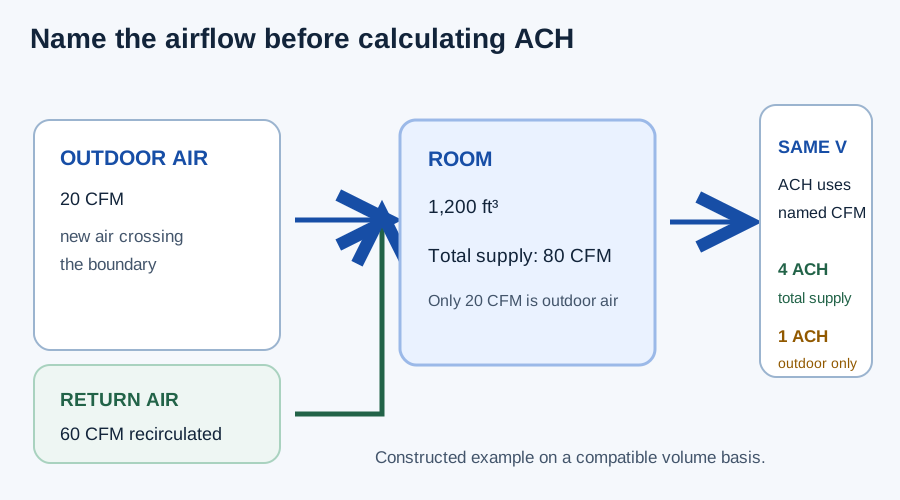
For a hypothetical total supply of 80 CFM with 25% outdoor air on a compatible volume basis, outdoor flow is 20 CFM. Total-supply ACH is 4.0, while outdoor-air ACH is 60 × 20 / 1,200 = 1.0. This illustrates why an unlabeled ACH number can mislead.
Zone example: with Pz = 1 person, Az = 252 ft², Rp = 5 CFM/person, Ra = 0.06 CFM/ft², and Ez = 1.0, Vbz = 5 × 1 + 0.06 × 252 = 20.12 CFM and Voz = 20.12 CFM. These are the calculator’s handbook-example inputs, not universal rates.
Dwelling example: 2,000 ft² and three bedrooms give a four-person baseline. With no credit, Qtot = 0.03 × 2,000 + 7.5 × 4 = 90 CFM. Continuous operation requires 90 CFM; a confirmed half-hour-on pattern every hour requires 90 / 0.5 = 180 CFM while on. The dwelling calculator reports these values. Retain full precision until the final display.
| Example | Independent result | Meaning |
|---|---|---|
| 1,200 ft³ at selected 4 ACH | 80.0 CFM | Flow corresponding to a selected room-volume ratio |
| 25% outdoor portion of that 80 CFM | 20 CFM; 1.0 outdoor-air ACH | Outdoor portion of the hypothetical total supply |
| 252 ft² zone with the listed Rp/Ra/Ez | 20.12 CFM Voz | Selected people/area method |
| 2,000 ft², three-bedroom dwelling, no credit | 90 CFM continuous; 180 CFM at 50% hourly on-time | Named historical dwelling equation path |
What to check after the calculation
Use the result with its purpose and source: an assumed air-change target, selected outdoor-air rates, or a named dwelling equation path. Verify the actual outdoor-air contribution, operating schedule, air distribution, local exhaust, replacement-air path, and delivered flow before using it in a design or field decision.
ACH does not describe how evenly air reaches people, how quickly every contaminant is removed, or how filtration affects particles. Neither an ACH conversion nor a ventilation-rate equation predicts building pressure. A well-defined CFM result is a starting point for the corresponding duct, equipment, control, and commissioning checks.
FAQs
Does ACH automatically mean outdoor-air ventilation? No. ACH can describe total supply, exhaust, or another named stream. Label the stream before interpreting the result.
Can a room ACH result size a multizone air handler? No. A central system needs its own zone-rate, primary-flow, diversity, and critical-zone calculation.
Does the calculator choose a current ventilation rate? No. Enter the rate and effectiveness from the applicable standard edition and project condition.
Conclusion and limits
Label the air stream first, then use ACH conversion or an outdoor-air method that matches the actual zone or dwelling task. Keep the selected rates, effectiveness, and operating schedule with the result.
These calculations do not establish contaminant control, building pressure, current code compliance, or delivered airflow.