
Insertion loss is only one part of selection
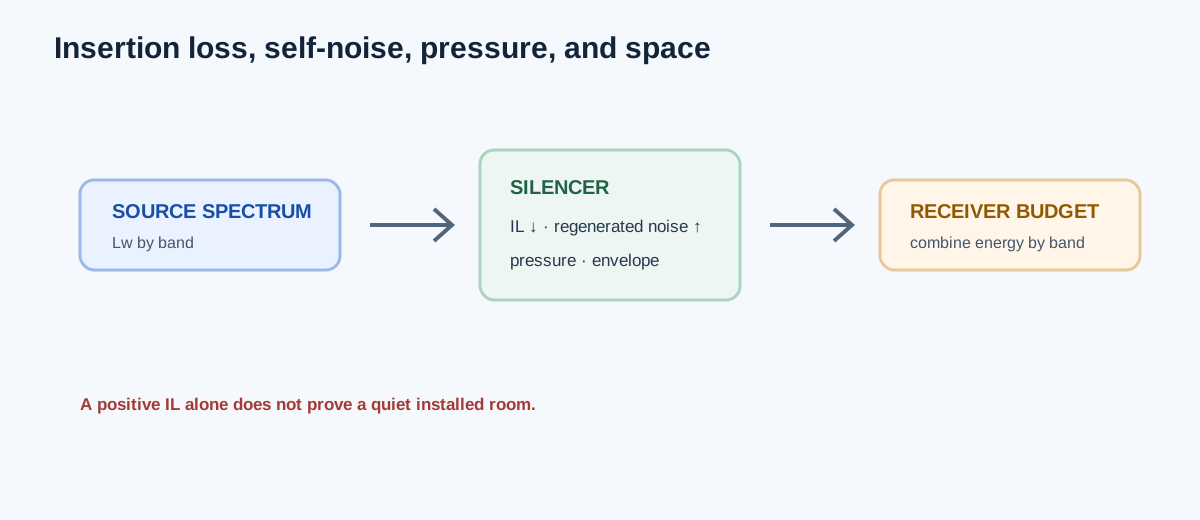
A silencer candidate must fit airflow, face velocity, pressure, envelope, and frequency-by-frequency acoustic limits. Dynamic insertion loss reduces transmitted source energy, while regenerated noise adds a new downstream source. A high insertion-loss number does not guarantee a low receiver level when self-noise or background already fills the budget.
The calculator ranks complete candidate conditions and combines independent transmitted and generated contributions energetically at the receiver. It keeps missing bands, lower-bound insertion loss, upper-bound generated noise, pressure, and envelope margins visible.
| Check | Input basis | Failure meaning |
|---|---|---|
| Flow | Signed actual airflow and face area | Rating cannot be transferred to another direction or flow |
| Pressure | Total pressure loss and budget | Candidate exceeds allocated pressure |
| Acoustics | Eight-band IL and regenerated noise | One band exceeds receiver budget |
| Envelope | Width, height, length and clearances | Candidate does not fit the installation |
| Receiver | Path transfer and independent background | Complete path budget is not supported |
Enter a complete candidate and receiver path
Document the exact model, configuration, rating revision, face area, signed flow, pressure drop, length, and installation envelope. Enter eight source bands, pre/post path losses, independent background where used, and the receiver model. Rating rows must match the actual signed flow and all eight frequencies; the tool does not interpolate a missing product point or transfer a point from another size.
Use the receiver budget as a path allocation. It is not automatically NC, RC, NR, dBA, or whole-room compliance. Keep product regenerated noise and independent background as separate energy contributions.
| Step | Record |
|---|---|
| 1 | Exact model, size, configuration, source revision |
| 2 | Signed airflow, face area, pressure and envelope |
| 3 | Source spectrum and upstream/downstream losses |
| 4 | Eight rating rows for IL and regenerated noise |
| 5 | Receiver path, background, and band budgets |
Independent 63 Hz candidate example
Use Candidate 1 in the worked example at 5,000 CFM through a 4 ft² face area, with 0.27 in. w.g. pressure drop against a 0.28 in. w.g. budget. At 63 Hz, source sound power is 80 dB, insertion loss is 6 dB, regenerated noise is 53 dB, receiver transfer is −7.387722 dB, and the allocated receiver budget is 60 dB.
Transmitted source power is 80−6 = 74 dB before the pre/post path losses of 3 and 5 dB, giving a downstream transmitted contribution of 66 dB re 1 pW. Generated noise is 53 dB before the same receiver transfer. Combining the compatible independent terms gives a receiver level of 58.686450 dB; budget margin is 60−58.686450 = 1.313550 dB. The candidate pressure margin is 0.01 in. w.g.
Face velocity = 5,000/4 = 1,250 FPM
Transmitted source = 80−6−3−5 = 66 dB
Combined receiver level = 58.686450 dB
Acoustic margin = 60−58.686450 = 1.313550 dB
Pressure margin = 0.28−0.27 = 0.01 in. w.g.
| Result | Independent value | Calculator display |
|---|---|---|
| Face velocity | 1,250 FPM | 1,250 FPM |
| Pressure margin | 0.01 in. w.g. | 0.01 in. w.g. |
| 63 Hz receiver level | 58.686450 dB | 58.686450 dB |
| 63 Hz budget margin | 1.313550 dB | 1.313550 dB |
Interpret fixed floors and candidate ranking
If fixed self-noise or background already meets or exceeds a band budget, the required insertion loss is withheld because no finite additional IL can solve that floor. If a candidate lacks one band, the complete eight-band selection is withheld even if the other bands pass.
A selected ID means the candidate met every entered criterion under the supplied data and ranking objective. It does not establish installed pressure taps, actual fan operating point, room response, product availability, or whole-room acceptance.
| Finding | Next check |
|---|---|
| High pressure loss | Review fan/system budget and exact product curve |
| One acoustic band fails | Inspect IL, regenerated noise, background, and path |
| Missing band | Obtain exact rating or withhold selection |
| Fixed floor unsupported | Resolve background/receiver budget before adding IL |
| Selected candidate | Verify actual submittal and installed path |
FAQs
Can I subtract regenerated noise from transmitted noise? No. Independent sound contributions combine by energy. Can a larger IL fix a background floor at the budget? No. A fixed floor can make the band impossible under the selected budget. Can a positive acoustic margin prove a quiet room? No; other sources, breakout, terminal self-noise, flanking, and background remain.
The calculator does not issue NC/RC/NR/dBA, current-code, ASTM, product-certification, or whole-room conclusions. Product data must match direction, size, configuration, flow, pressure, and source revision.
Conclusion and limits
Select a silencer only after matching the actual flow and product ratings, combining transmitted and regenerated sound at the receiver, and checking every pressure, envelope, and octave-band margin. Preserve unsupported and bound-based rows instead of replacing them with quiet assumptions.
The ASHRAE acoustic method and product data boundaries support the calculation structure. They do not certify a product, guarantee installed attenuation, or establish total-room compliance.