
Choose the mixing model before interpreting the fraction
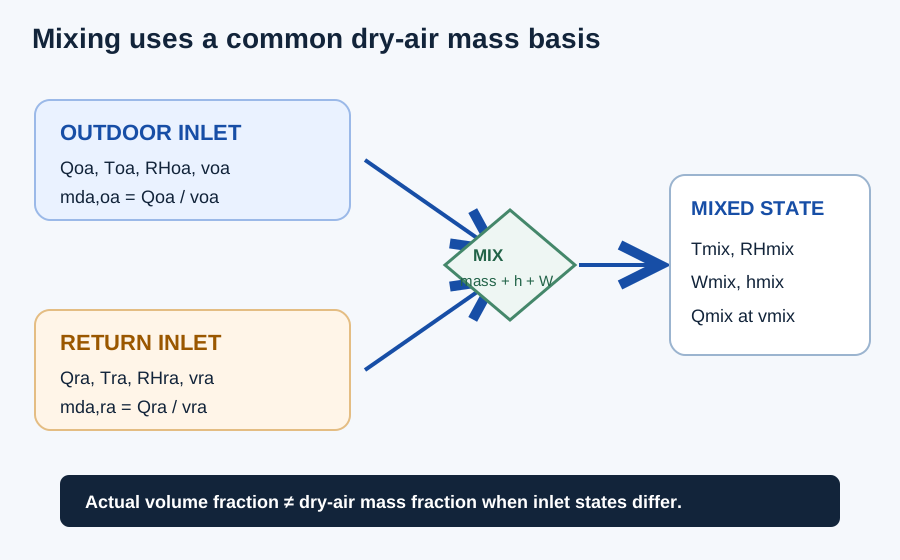
Outdoor and return air mix by conserving dry-air mass, moisture, and energy under an adiabatic, single-gas-phase model. A simple dry-bulb average can be useful when equal density and specific heat are reasonable assumptions. When actual inlet states differ, actual CFM must first be converted to dry-air mass before averaging moisture and enthalpy.
The calculator provides three modes: sensible mixed temperature, a three-temperature outdoor-fraction diagnostic, and actual moist-air mixing. A temperature-derived fraction is not automatically a measured volume fraction, a damper position, or proof of sufficient outdoor ventilation.
| Mode | Inputs | Output basis |
|---|---|---|
| Sensible mixed temperature | Outdoor/return dry bulbs and outdoor percent | Equal-density/equal-cp estimate |
| Three-temperature diagnostic | Outdoor, return and representative mixed dry bulbs | Inferred fraction under the same sensible assumptions |
| Actual moist-air mixing | Two ACFM values, two dry-bulb/RH states and common absolute pressure | Dry-air mass, water and enthalpy balance |
Enter the temperature-only modes correctly
For a sensible estimate, enter outdoor and return inlet temperatures in °F and outdoor fraction from 0% to 100%. The tool assumes equal density and specific heat, no leakage, and no fan or coil heat between the measurements. Temperatures must be above absolute zero.
For the inverse diagnostic, replace outdoor percent with a representative mixed temperature. The inferred fraction must lie from 0% to 100%, so the mixed temperature must fall between the two inlet temperatures. The tool withholds the diagnostic when inlet temperatures differ by less than 1°F. That is an implementation stability guard, not a standard measurement tolerance.
Tmix = x Toa + (1 − x) Tra
Inverse: x = (Tmix − Tra) / (Toa − Tra)
Outdoor percent = 100x
| Condition | Effect on interpretation | Check |
|---|---|---|
| Inlet temperatures too close | Small measurement errors produce large fraction changes | Use a suitable independent airflow measurement |
| Fan/coil heat between sensors | Mixed temperature includes another energy input | Confirm sensor planes and heat-source locations |
| Stratified mixed stream | One temperature may not represent the mixture | Establish a representative measurement |
| Different density or moisture states | A volume-weighted dry-bulb average is approximate | Use actual-state mixing when its inputs are established |
Use actual inlet flows and states for moist-air mixing
Select Mix two actual moist-air streams by dry-air mass. Record the source and confirm steady adiabatic mixing at a common total absolute pressure. Enter outdoor and return actual inlet CFM, each dry bulb from −40°F to 140°F, each RH from 0% to 100%, and positive common pressure in psia. The pressure is barometric absolute pressure, not duct gauge pressure.
Both inlet states are required even if one stream’s flow is zero; at least one flow must be positive. The tool obtains humidity ratio W, enthalpy h, and specific volume v for each inlet using named ASHRAE 2017 perfect-gas moist-air relations. It divides each actual flow by its own v to obtain dry-air lb/min. Relative humidity is derived after mixing rather than averaged.
A balance that would be supersaturated is withheld and needs a condensation or ice-equilibrium model. The tool does not force such a result to 100% RH. It also does not model pressure loss, fan heat, leakage, coil duty, or economizer control.
ṁda,i = Qi / vi, in lb dry air/min
xda,oa = ṁda,oa / (ṁda,oa + ṁda,ra)
Wmix = xda,oa Woa + (1 − xda,oa) Wra
hmix = xda,oa hoa + (1 − xda,oa) hra
Tmix = (hmix − 1061 Wmix) / (0.240 + 0.444 Wmix)
Qmix = (ṁda,oa + ṁda,ra) vmix
| Quantity | Meaning | Unit |
|---|---|---|
| Q | Actual volume flow at the stated stream condition | ACFM |
| v | Specific volume per dry-air mass | ft³/lb dry air |
| W | Water-vapor mass per dry-air mass | lb water/lb dry air |
| h | Moist-air enthalpy on the stated dry-air basis | BTU/lb dry air |
| xda,oa | Outdoor fraction of dry-air mass flow | dimensionless |
| RH | Relative humidity at the calculated temperature | %; not directly additive |
Independent sensible example and its inverse
Use outdoor air at 40°F, return air at 75°F, and a selected outdoor fraction of 20% on the equal-density/equal-cp basis. Tmix = 0.20 × 40 + 0.80 × 75 = 68°F. Reversing the equation, x = (68 − 75)/(40 − 75) = 0.20, or 20%. Both results match the corresponding calculator modes.
The 35°F inlet separation meets the tool’s 1°F diagnostic guard. This numerical agreement checks the algebra; it does not validate field sensors, the equal-property assumption, or the actual outdoor airflow.
0.20 × 40 + 0.80 × 75 = 68°F
(68 − 75)/(40 − 75) = 0.20 = 20%
Independent moist-air example
Use a constructed outdoor stream of 500 ACFM at 95°F and 60% RH, a return stream of 2,000 ACFM at 75°F and 50% RH, and a common 14.696 psia. Independently applying the cited property equations gives outdoor v = 14.46528334 ft³/lb dry air and return v = 13.67918365 ft³/lb dry air. Their dry-air mass flows are 500/v = 34.56551719 and 2,000/v = 146.20755529 lb/min.
Outdoor dry-air mass fraction is 34.56551719/(34.56551719 + 146.20755529) = 0.19120944, or 19.121%. Outdoor volume is 20% of the two inlet volumes. Those two fractions differ because inlet specific volumes differ.
The inlet humidity ratios are 0.02144099 and 0.00923567 lb/lb dry air; enthalpies are 46.45327391 and 28.10659499 BTU/lb dry air. Mass-weighting gives Wmix = 0.01156944 and hmix = 31.61465311. Substitution into the temperature equation gives 78.89256398°F. Evaluating the mixed state gives 54.85409657% RH and v = 13.82971895 ft³/lb dry air; mixed actual airflow is 2,500.040785 ACFM.
The calculator displays 78.893°F, 54.854% RH, 19.121% dry-air mass fraction, and 2,500.041 ACFM. These agree with the independent calculation after rounding. Intermediate values above are shortened for reading; use unrounded properties when reproducing the final digits.
| Result | Independent value | Calculator display |
|---|---|---|
| Outdoor dry-air mass fraction | 19.12094358% | 19.121% |
| Outdoor share of inlet actual volumes | 500/2,500 = 20% | 20% |
| Mixed dry bulb | 78.89256398°F | 78.893°F |
| Mixed RH | 54.85409657% | 54.854% |
| Mixed actual airflow | 2,500.040785 ACFM | 2,500.041 ACFM |
Use the result with its measurement and model limits
Compare a mixing result with measurements from representative, simultaneous inlet and mixed conditions. Review stratification, damper leakage, sensor placement, and nearby heat sources when they disagree. The calculation cannot identify the cause from temperatures alone.
For a coil-entering state, carry the mixed humidity ratio and enthalpy as well as dry bulb into an appropriate load calculation. For ventilation, establish the outdoor-air requirement separately. A plausible temperature or dry-air mass fraction does not prove ventilation compliance or supply a damper command.
FAQs
Does a temperature-derived fraction equal damper position? No. Leakage, stratification, unequal properties, and sensor placement can change the relationship.
Can the sensible model establish ventilation compliance? No. Establish the outdoor-air requirement separately.
When is the moist-air mode needed? Use it when humidity, dry-air mass, or enthalpy materially affects the mixing result.
Conclusion and limits
Select the simplest model that matches the available measurements, and retain temperature, mass, humidity, and enthalpy quantities on their stated bases.
The result does not issue a damper command or prove ventilation, coil, or economizer performance.