
A temperature ratio describes one side of the exchanger
A measured supply temperature ratio compares the supply stream’s temperature change with the difference between the two entering temperatures. Sensible exchanger effectiveness compares transferred heat with the maximum sensible transfer set by the smaller heat-capacity rate. For nonzero recovery and a nonzero entering temperature difference, they coincide in the ideal model only when the supply side has the minimum heat-capacity rate. They are not interchangeable for every flow arrangement.
The Sensible Heat Recovery Calculator keeps the measured diagnostic and predictive model in separate modes. The first uses three measured temperatures and standard-air supply CFM. The second needs both actual inlet flows, dry-air densities, compatible specific heats, entering temperatures, and a sensible effectiveness established for those conditions.
| Quantity | Definition | Interpretation |
|---|---|---|
| Supply temperature ratio | (Ts,out − To,in)/(Te,in − To,in) | Apparent supply-side approach to the entering extract temperature |
| Sensible effectiveness ε | q/[Cmin(Te,in − To,in)] | Transfer relative to the minimum-capacity-rate limit |
| Certified recovery efficiency | Depends on a specified rating procedure | Not calculated or certified by these modes |
Use measured mode for a temperature diagnostic
Enter Outdoor entering temperature, Extract air entering the exchanger, Supply air leaving the exchanger, and Measured supply airflow. All temperatures are in °F; supply airflow is positive CFM. Place the measurements at the stated exchanger boundaries. Extract entering temperature is not the exhaust leaving temperature.
The tool withholds the ratio if entering outdoor and extract temperatures differ by less than 1°F. This is its stability guard, not a standard tolerance. It retains an apparent ratio outside 0–100% with a warning to investigate the measurement and model, rather than clipping it to a plausible value. The associated heat uses fixed standard-air density 0.075 lb/ft³ and cp 0.24 BTU/(lb·°F), giving the factor 1.08.
Measured ratio = (Ts,out − To,in)/(Te,in − To,in)
Standard-air supply heat = 1.08 × CFM × (Ts,out − To,in)
Use predictive mode only with matching effectiveness and properties
Enter Supply actual inlet airflow and Extract actual inlet airflow in ACFM at their respective inlet states. Supply the dry-air density for each state in lb dry air per ft³ of inlet air and compatible constant specific heat per pound of dry air. Dry-air density is 1/v when v is specific volume per pound of dry air; it is not total moist-air density.
Enter the two inlet dry bulbs and an applicable sensible exchanger effectiveness from 0% to 100%. Record its source at the actual flow ratio and operating condition, then confirm the dry sensible model. A balanced-flow catalog rating does not automatically apply to unequal flows. Equal ACFM does not itself establish equal heat-capacity rates.
The model requires steady operation without moisture transfer, condensation, frost, leakage between streams, bypass, fan heat, or surrounding heat transfer. There are no humidity inputs, so the calculator cannot verify that condensation or frost is absent. Establish the dry operating basis separately.
Cs = 60 Qs ρda,s cp,da,s; Ce = 60 Qe ρda,e cp,da,e
Cmin = min(Cs, Ce)
qto supply = ε Cmin(Te,in − To,in)
Ts,out = To,in + q/Cs; Te,out = Te,in − q/Ce
Supply approach = ε Cmin/Cs; extract approach = ε Cmin/Ce
| Input or result | Unit | Meaning |
|---|---|---|
| Q at each inlet | ACFM | Actual volume at that stream’s stated inlet condition |
| ρda | lb dry air/ft³ | Dry-air mass per inlet air volume |
| cp,da | BTU/(lb dry air·°F) | Compatible effective sensible specific heat |
| C | BTU/(h·°F) | Heat-capacity rate, 60Qρda cp,da |
| ε | % in the form; fraction in equations | Applicable sensible exchanger effectiveness |
| q | BTU/h | Positive warms supply; negative cools it |
Independent measured-temperature example
Use outdoor entering air at 20°F, extract entering at 70°F, supply leaving at 55°F, and 200 CFM. The apparent supply ratio is (55 − 20)/(70 − 20) = 35/50 = 0.70, or 70%. Standard-air sensible heat to supply is 1.08 × 200 × 35 = 7,560 BTU/h. These independently calculated values match measured mode.
The result is an apparent ratio at the supplied conditions, not an independently established exchanger effectiveness or certified rating. Heat added by a fan between the relevant measurement planes, bypass operation, or unrepresentative sensor locations could affect that ratio.
| Calculation | Independent result | Calculator result |
|---|---|---|
| Supply temperature change | 55 − 20 = 35°F | 35°F |
| Entering temperature difference | 70 − 20 = 50°F | Used in the ratio |
| Apparent ratio | 35/50 × 100 = 70% | 70% |
| Heat to supply | 1.08 × 200 × 35 = 7,560 BTU/h | 7,560 BTU/h |
Independent unequal-capacity example
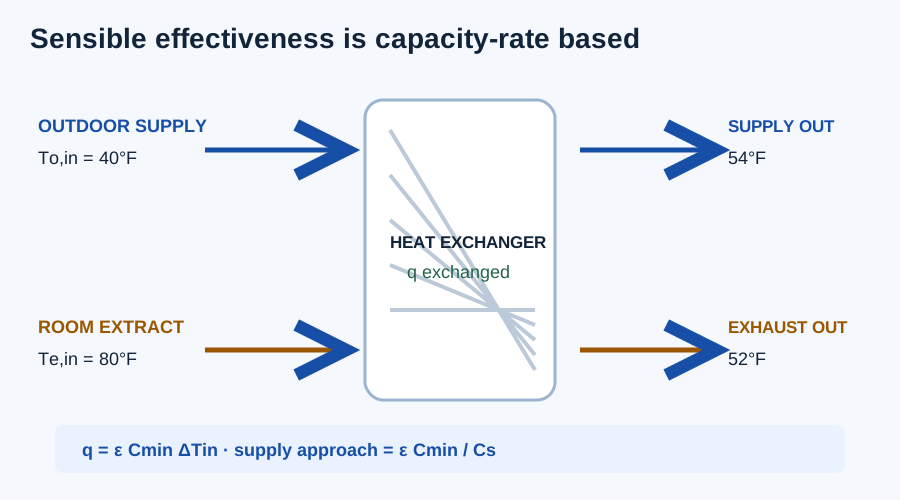
For a separate constructed dry sensible example, let supply inlet flow be 200 ACFM and extract inlet flow be 100 ACFM. Assume both have dry-air density 0.075 lb/ft³ and cp 0.24 BTU/(lb dry air·°F). Use outdoor entering temperature 40°F, extract entering 80°F, and applicable effectiveness 70%. These properties are explicit teaching assumptions, not inferred from the temperatures.
Cs = 60 × 200 × 0.075 × 0.24 = 216 BTU/(h·°F); Ce = 108, so Cmin = 108. Heat to supply is 0.70 × 108 × (80 − 40) = 3,024 BTU/h. Supply leaves at 40 + 3,024/216 = 54°F, and exhaust leaves at 80 − 3,024/108 = 52°F.
The supply temperature ratio is (54 − 40)/(80 − 40) = 35%, while the specified exchanger effectiveness is 70%. The extract approach is 70%. These values match predictive mode and show why using 70% as the supply temperature ratio would overpredict the supply outlet temperature in this case.
| Quantity | Independent calculation | Result |
|---|---|---|
| Supply capacity rate | 60 × 200 × 0.075 × 0.24 | 216 BTU/(h·°F) |
| Extract capacity rate | 60 × 100 × 0.075 × 0.24 | 108 BTU/(h·°F) |
| Heat to supply / exhaust | ±0.70 × 108 × 40 | +3,024 / −3,024 BTU/h |
| Supply / exhaust outlet | 40 + 3,024/216; 80 − 3,024/108 | 54°F / 52°F |
| Supply approach / effectiveness | ε Cmin/Cs; supplied ε | 35% / 70% |
Interpret the result without extending the model
For measured mode, review sensor positions, simultaneous operation, airflow balance, bypass, fan heat, and frost controls before interpreting an unexpected ratio. For predictive mode, confirm that the supplied effectiveness and property basis apply at both inlet flows and across the modeled temperature changes.
The predictive equations also support equal entering temperatures: transfer is zero even if the specified effectiveness is nonzero. A measured temperature ratio would be undefined in that condition, which is another reason to keep the two modes separate. Neither result establishes latent or total recovery, certified SRE/ASRE, net electrical savings, annual performance, or code compliance.
FAQs
Is measured temperature ratio the same as exchanger effectiveness? Not necessarily. Capacity rates, flow imbalance, leakage, and the selected model matter.
Does the calculator include moisture transfer or frost? No. The dry sensible model requires those conditions to be handled separately.
Can a balanced-flow catalog effectiveness be used for unequal flows? Only when its source basis supports the actual capacity-rate condition.
Conclusion and limits
Keep measured temperature ratios, sensible effectiveness, capacity rates, and humidity effects distinct. Use the selected mode only within its stated dry-air assumptions.
The calculator does not certify exchanger performance, frost control, moisture transfer, or ventilation adequacy.