
Energy cost follows electrical input and time
Fan energy cost uses electrical kW multiplied by hours, then applies the entered energy-only rate. Shaft BHP and air power are useful duty-point quantities, but they are not electrical consumption. Motor and drive efficiency are already represented only if the electrical kW input was derived with those boundaries.
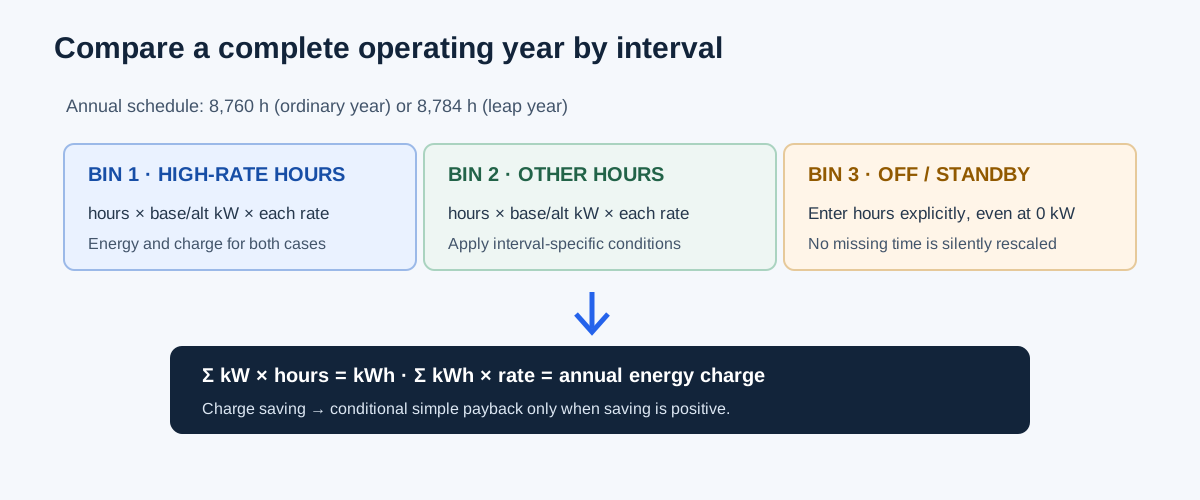
Average mode is appropriate when one operating-average electrical input and one rate represent the comparison. Schedule mode preserves changing load states and rates by bin. A complete year must include off or standby periods explicitly; missing hours are not silently treated as zero or rescaled.
| Mode | Inputs | Best use |
|---|---|---|
| Annual average | Average baseline/alternative kW, annual hours, one rate | Stable or intentionally averaged operating comparison |
| Full-year schedule | 1–100 bins covering 8,760 or 8,784 hours | Changing loads, rates, off periods, and documented scenarios |
| Simple payback | Incremental cost and positive annual charge saving | Conditional energy-charge payback only |
Use electrical kW and equivalent fan service
For average mode, enter baseline and alternative average electrical input in kW, annual operating hours for each, the user’s energy-only tariff in USD/kWh, and incremental upgrade cost. Different hours are allowed, but the two scenarios must still provide the intended equivalent fan service before the savings are meaningful.
For schedule mode, confirm the annual comparison basis and select 8,760 hours for an ordinary year or 8,784 for a leap year. Enter rows of hours, baseline kW, alternative kW, baseline rate, and alternative rate. Rates are nonnegative and user-supplied; demand charges, fixed charges, taxes, tiers, export credits, and minimum bills are outside the calculator.
Average energy: E = electrical kW × operating hours
Schedule energy: E = Σ(kWi × hi)
Schedule charge: C = Σ(kWi × hi × ratei)
Energy saving = Ebaseline − Ealternative
Charge saving = Cbaseline − Calternative
Payback = upgrade cost / positive annual charge saving
| Input/result | Unit | Boundary |
|---|---|---|
| Electrical input | kW | Measured or justified electrical power, not shaft BHP |
| Hours | h/year | Complete annual accounting in schedule mode |
| Energy rate | USD/kWh | Energy-only rate for the applicable bin |
| Annual energy | kWh/year | Sum of electrical kW × hours |
| Annual charge | USD/year | Sum of bin energy × its rate |
| Payback | years | Reported only when annual charge saving is positive |
Choose a mode and enter its matching data
In average mode, enter baseline and alternative electrical kW, each case’s annual hours, the shared energy-only USD/kWh rate, and incremental upgrade cost. In schedule mode, confirm the complete-year basis, select 8,760 or 8,784 hours, then enter one or more rows of hours, baseline and alternative kW, and each case’s rate. Include off hours as explicit zero-power rows.
Check that schedule-bin hours sum to the selected year and that each scenario delivers comparable fan service. Results recalculate from the entered values. If annual energy-charge savings are not positive, no positive simple payback is shown.
| Mode | Input sequence | Validation/result check |
|---|---|---|
| Average | Electrical kW, hours, shared rate, upgrade cost | Hours cannot exceed a leap year; compare equivalent service |
| Schedule | Year basis, then hours/kW/rates for every bin | Bins must cover exactly the full selected year |
| Both | Review energy, energy charges, and payback if present | Tariff and electrical inputs remain user-supplied scenarios |
Independent average-input example
Use baseline electrical input 2.0 kW for 2,000 hours/year, alternative electrical input 1.2 kW for the same 2,000 hours/year, energy rate $0.15/kWh, and incremental cost $1,000. Baseline energy = 2.0 × 2,000 = 4,000 kWh. Alternative energy = 1.2 × 2,000 = 2,400 kWh. At the entered rate, charges are $600 and $360.
Annual energy saving is 1,600 kWh; annual energy-charge saving is $240. Simple payback = $1,000/$240 = 4.1666667 years, displayed as about 4.167 years. This excludes demand charges, maintenance, financing, rate changes, and any difference in delivered fan service.
Ebase = 2.0 × 2,000 = 4,000 kWh
Ealt = 1.2 × 2,000 = 2,400 kWh
C saving = (4,000 − 2,400) × 0.15 = $240/year
Payback = $1,000/$240 = 4.1666667 years
| Result | Independent value | Calculator display |
|---|---|---|
| Baseline energy | 4,000 kWh/year | 4,000 kWh/year |
| Alternative energy | 2,400 kWh/year | 2,400 kWh/year |
| Energy-charge saving | $240/year | $240/year |
| Simple payback | 4.1666667 years | About 4.167 years |
Independent complete-year schedule example
Use a constructed ordinary year with 1,000 hours at 2.0/1.2 kW and $0.25/kWh for both scenarios, another 1,000 hours at the same powers and $0.10/kWh, and 6,760 explicit off hours at zero kW and $0.10/kWh. The hours sum is 8,760.
Baseline energy = 1,000×2 + 1,000×2 = 4,000 kWh; alternative energy = 1,000×1.2 + 1,000×1.2 = 2,400 kWh. Baseline charge = 2,000×$0.25 + 2,000×$0.10 = $700. Alternative charge = 1,200×$0.25 + 1,200×$0.10 = $420. Charge saving is $280/year; payback is $1,000/$280 = 3.5714286 years. The rate is applied per bin, not averaged first.
Hours = 1,000 + 1,000 + 6,760 = 8,760 h
Cbase = 2,000×0.25 + 2,000×0.10 = $700
Calt = 1,200×0.25 + 1,200×0.10 = $420
Payback = $1,000/($700−$420) = 3.5714286 years
| Bin | Hours | Baseline / alternative kW | Rate | Baseline / alternative charge |
|---|---|---|---|---|
| 1 | 1,000 | 2.0 / 1.2 | $0.25/kWh | $500 / $300 |
| 2 | 1,000 | 2.0 / 1.2 | $0.10/kWh | $200 / $120 |
| 3: off | 6,760 | 0 / 0 | $0.10/kWh | $0 / $0 |
| Total | 8,760 | — | — | $700 / $420 |
Interpret savings and payback carefully
A positive energy saving does not guarantee a positive charge saving when rates differ by scenario or bin. A negative charge saving means the alternative costs more under the entered energy-only rates, so the calculator does not report a positive payback. The hours check confirms arithmetic coverage, not that bins are non-overlapping or that the recorded kW is valid.
Do not fill electrical kW from fan laws automatically. A VFD or speed change needs a real fan/system operating point, motor/drive efficiency, control schedule, and electrical measurement or justified model. Check equivalent airflow and pressure service before calling a lower-power case a saving.
| Outside scope | Why it matters |
|---|---|
| Demand and fixed charges | They can change the utility bill without changing kWh |
| Maintenance and service life | Energy payback is not life-cycle cost |
| Equivalent fan service | Lower kW may reflect lower delivered airflow |
| Automatic affinity-law savings | Power depends on real operating point and system resistance |
| Tariff eligibility and taxes | User-entered rates are scenarios, not a utility determination |
FAQs
Why use electrical kW instead of BHP? kW represents electrical input at the modeled boundary. Shaft horsepower excludes motor and drive losses unless those losses have already been included in an independently justified electrical measurement or conversion.
Does the annual schedule verify when bins occur or whether they overlap? No. The total-hour check verifies arithmetic coverage only. Keep a separate, non-overlapping operating calendar and use rates applicable to each interval.
Is payback a utility-bill or life-cycle forecast? No. It includes only the entered energy charge and upgrade cost. Demand charges, fixed charges, taxes, maintenance, financing, service life, rate escalation, and tariff eligibility are outside this calculator.
Conclusion and limits
Use electrical kW, hours, and applicable energy-only rates to construct the comparison. Use schedule mode when the operating year contains distinct load, rate, or off-state intervals. Interpret payback as conditional on equivalent service, entered data, and positive annual charge savings.
The cited fan and energy sources provide performance context. The calculator does not forecast a tariff, derive VFD savings, or certify a utility bill or life-cycle investment.