
A test flow is tied to its pressure and boundary
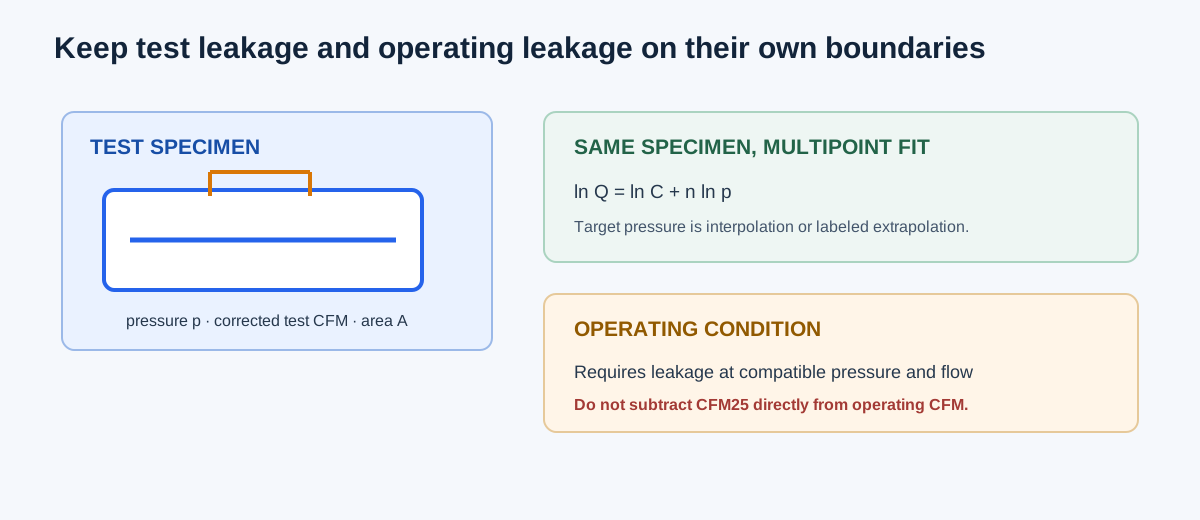
Leakage CFM is meaningful only with its pressure difference, test direction, measurement correction, and duct boundary. CFM25 is a test condition; it is not a universal operating leakage value and must not be subtracted directly from a fan airflow unless a compatible pressure-flow relationship establishes that conversion.
The leakage workbench keeps several decisions separate: compare a measured test flow with an externally selected allowance, compute a percentage on the same airflow basis, subtract leakage only when the operating condition is compatible, compare before and after tests, check a supplied leakage class, allocate a whole-system target to tested sections, or fit a power-law curve from multipoint readings.
| Quantity | Requires | Use |
|---|---|---|
| Test leakage CFM | Test pressure, direction, specimen, correction basis | Compare the same test method or fit the same specimen |
| Leakage class | Class criterion, pressure magnitude, actual duct surface area | Normalize a compatible test result to the stated class basis |
| Operating leakage | Leakage at the operating pressure/flow basis | Subtract only from a compatible operating airflow |
| Fitted target flow | At least three same-specimen pressure/flow observations | Estimate a stated target pressure and label extrapolation |
Choose the mode and enter the actual test basis
For a class check, confirm the protocol-corrected test CFM, positive test-pressure magnitude in inches of water gauge, actual duct surface area inside the test boundary, and the project-supplied leakage class. The workbench does not select a nationwide class or adopt a code limit automatically. Use surface area rather than floor area.
For section allocation, enter the complete system maximum fan airflow, supplied whole-system target percentage, complete system duct surface area, and nonoverlapping tested sections with each section’s area, test pressure, and corrected measured leakage. A section’s spare allocation cannot offset another section’s excess, and an accepted subset does not accept untested surface area.
For a multipoint fit, use one unchanged specimen and boundary, one pressure direction, compatible baseline and instrument corrections, at least three distinct pressure levels, and positive corrected CFM. Enter pressure magnitude in Pa and the target pressure in Pa. The fit uses equal-weight least squares in natural-log space: ln(Q) = ln(C) + n ln(p). A target outside the measured range is marked extrapolated.
| Mode | Enter | Critical check |
|---|---|---|
| Class check | Class, pressure, area, measured CFM | Class and CFM share the documented protocol basis |
| Section allocation | System flow, target %, system area, section rows | Rows are nonoverlapping parts of one complete boundary |
| Multipoint fit | Same-specimen pressure/CFM pairs and target pressure | Do not mix sections, directions, or before/after states |
| Operating subtraction | System flow and leakage at the same operating basis | CFM25 is not a substitute for operating leakage |
Independent leakage-class example
Use leakage class CL = 4 CFM/100 ft² at 1 in. w.g., test pressure p = 3 in. w.g., duct surface area A = 1,000 ft², and measured test leakage Q = 80 CFM. The pressure factor is 3^0.65 = 2.042343632. Allowable leakage is CL × p^0.65 × A/100 = 4 × 2.042343632 × 10 = 81.693745 CFM. The measured flow is within the entered criterion with a margin of 1.693745 CFM.
The measured normalized class is Q × 100/(A × p^0.65) = 80 × 100/(1,000 × 2.042343632) = 3.917069 CFM/100 ft² at 1 in. w.g. The calculator displays the same values after rounding. Keep the full precision for the comparison and round only the displayed result.
Pressure factor = |p|^0.65 = 3^0.65 = 2.042343632
Allowable Q = CL × |p|^0.65 × A/100 = 81.693745 CFM
Measured class = Q × 100/(A × |p|^0.65) = 3.917069
Margin = allowable Q − measured Q = 1.693745 CFM
| Result | Independent value | Calculator display |
|---|---|---|
| Pressure factor | 2.042343632 | 2.042343632 |
| Class-based allowable leakage | 81.693745 CFM | 81.693745 CFM |
| Measured leakage class | 3.917069 | 3.917069 |
| Allowance margin | 1.693745 CFM | 1.693745 CFM |
Independent multipoint fit example
Use four observations from one constructed unchanged specimen: (4 Pa, 20 CFM), (16 Pa, 40 CFM), (36 Pa, 60 CFM), and (64 Pa, 80 CFM). The points follow Q = 10√p exactly, so n = 0.5 and C = 10 CFM/Pa^0.5. At a target pressure of 25 Pa, Q = 10√25 = 50 CFM. Because 25 Pa lies between the measured 4–64 Pa range, the result is an interpolation rather than an extrapolation.
The log-space fit reports a fitted exponent of 0.5, flow coefficient 10, R² of 1 for these constructed data, and zero residuals before display rounding. This is a mathematical fit, not a test certification. A different specimen, pressure direction, sealing condition, baseline correction, or pressure range can produce a different relationship.
ln Q = ln C + n ln p
For Q = 10√p: n = 0.5, C = 10
At p = 25 Pa: Q = 10 × √25 = 50 CFM
| Item | Value |
|---|---|
| Input observations | (4,20), (16,40), (36,60), (64,80) Pa/CFM |
| Fitted pressure exponent n | 0.5 |
| Flow coefficient C | 10 CFM/Pa^0.5 |
| Target pressure | 25 Pa, within measured range |
| Fitted leakage at target | 50 CFM |
Interpret a passing or failing result
A class-check pass means the entered test flow is at or below the supplied class-based allowance for that test pressure and surface area. It does not prove a code requirement, sealing quality, operating leakage, or complete system performance. A section-allocation pass means every entered section is within its own allocation; inspect unrepresented area separately.
A before/after reduction is useful only when the pressure, boundary, direction, instrument method, and correction basis are comparable. A lower CFM25 result may reflect a changed test boundary or protocol if those conditions are not controlled. A fitted target outside the measured range is an extrapolation and needs stronger evidence before it is used as an operating estimate.
| Finding | Next check |
|---|---|
| Test flow exceeds allowance | Confirm boundary, correction, pressure, surface area, and sealing scope before retesting |
| Only a subset of area was tested | Test or account for the remaining complete boundary |
| Target pressure is extrapolated | Add compatible measurements around the target or keep the result qualified |
| Operating leakage is needed | Obtain a compatible pressure-flow model; do not subtract CFM25 directly |
FAQs
Is a leakage class the same as a seal class? No. The workbench applies the supplied class equation to the entered test basis; it does not map a result to a construction or seal certification.
Can I add test flows from sections tested at different pressures? No. The tool reports their bookkeeping separately. Different pressure tests are not simultaneous operating flows.
Does R² prove the fitted model is valid in the field? No. It describes the fit to the entered observations. Measurement uncertainty, pressure distribution, specimen changes, and applicability at the target remain separate questions.
Conclusion and limits
Keep test pressure, corrected leakage flow, duct surface area, specimen boundary, and protocol together. Use the class and allocation modes only with supplied project criteria, and use a multipoint fit only for one compatible unchanged specimen. Treat operating leakage as a separate pressure-flow question.
The cited leakage equations and project-specific criteria define the implemented arithmetic. They do not supply a default code limit, certify a test, convert CFM25 to operating leakage, or approve a duct system.