
Product selection starts with a named condition
A commercial hood or outdoor-air louver result is meaningful only when the model, size, accessory configuration, airflow, pressure basis, installation geometry, and source test condition match. Generic exhaust rules or free-area velocity rules cannot replace a product submittal.
The hood calculator checks a named CaptiveAire ND-2 profile and keeps catalog exhaust, nameplate minimum, appliance coverage, temperature, mounting clearance, and direct hood supply as separate checks. The louver calculator keeps gross, free, and core area distinct and requires exact static-air or wind-driven-rain evidence.
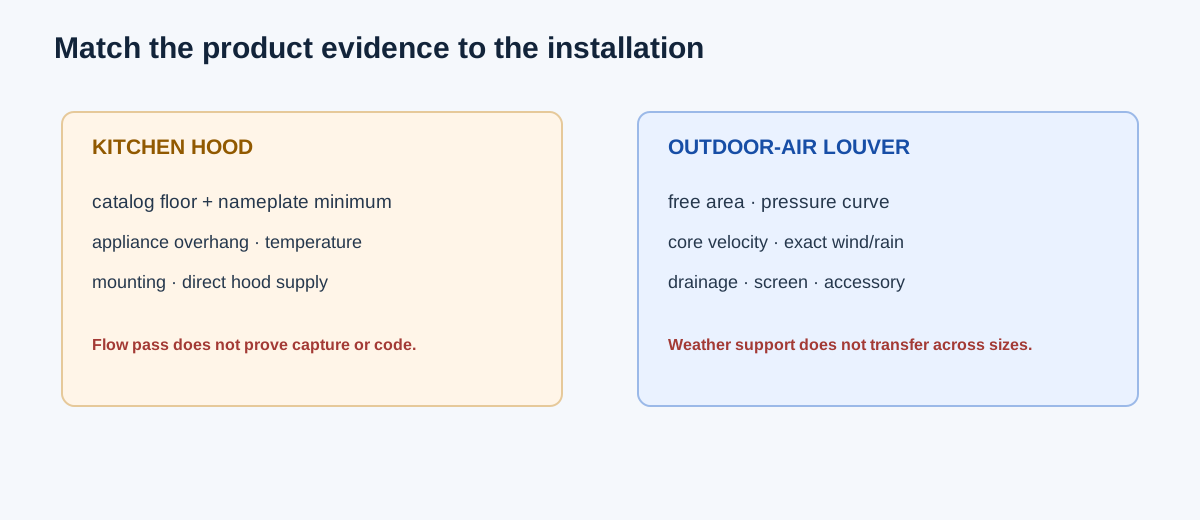
| Task | Primary evidence | Separate limit |
|---|---|---|
| Kitchen hood | Named model, configuration, temperature row, appliance layout | Nameplate exhaust, overhang, mounting, direct supply |
| Still-air louver | Free area, pressure curve, water-penetration point | Opening envelope and selected velocity screen |
| Wind/rain louver | Core area, exact wind/rain test, rejection | Pressure curve and installed drainage/accessories |
Enter source rows and installation conditions
For a hood, select single-wall or equal-length back-to-back, temperature row, hood length/depth, actual nameplate limits, proposed exhaust/direct supply, and one rear-aligned nonoverlapping appliance row per bank. The calculator does not average appliance temperatures or turn a higher fan flow into a capture guarantee.
For a louver, enter the available opening, pressure budget, pressure basis, candidate dimensions/free or core area, and same-candidate pressure points. Static air uses free-area velocity and a documented water screen. Wind-driven rain uses core velocity, exact wind/rain conditions, and rejection data; a lower wind condition is not automatically supported.
| Step | Hood | Louver |
|---|---|---|
| 1 | Identify model/configuration | Identify exact model/accessory |
| 2 | Enter coverage and limits | Enter opening and pressure budget |
| 3 | Enter appliance rows | Enter candidate geometry and area |
| 4 | Enter flows and source row | Enter matching pressure/weather rows |
| 5 | Review every margin | Separate unsupported states from failures |
Independent hood example
Use a 48 in single-wall ND-2 hood at the 450°F row, 150 CFM/ft, with a constructed 54 in coverage depth. One appliance starts 6 in from the left, is 36 in wide and 30 in deep, and the entered front/side requirements are 6 in. Nameplate minimum is 600 CFM; proposed exhaust is 800 CFM; direct supply is 400 CFM against a 500 CFM maximum.
Catalog floor is (48/12)×150 = 600 CFM, so governing minimum is max(600,600,0) = 600 CFM. Left and right overhangs are 6 in; front overhang is 54−30 = 24 in. Exhaust margin is 200 CFM and direct-supply margin is 100 CFM. The source benchmark supports the catalog arithmetic only; construction inputs must be replaced with actual assembly documents.
Catalog floor = (48/12) × 150 = 600 CFM
Governing minimum = max(600, 600, 0) = 600 CFM
Front overhang = 54−30 = 24 in
Exhaust margin = 800−600 = 200 CFM
Direct supply margin = 500−400 = 100 CFM
| Result | Independent value | Calculator display |
|---|---|---|
| Catalog floor | 600 CFM | 600 CFM |
| Governing minimum | 600 CFM | 600 CFM |
| Front overhang | 24 in | 24 in |
| Exhaust margin | 200 CFM | 200 CFM |
| Direct supply margin | 100 CFM | 100 CFM |
Independent louver examples
For 6,000 CFM through a 48×48 in candidate with 8.92 ft² free area and 989 FPM beginning-water-penetration point, free-area velocity is 6,000/8.92 = 672.645740 FPM. At 0.073 in. w.g. pressure and a 0.10 in. w.g. budget, pressure margin is 0.027 in. w.g.; the velocity is below the entered weather screen.
For a wind/rain candidate with 12 ft² core area, 8 ft² free area, 29 mph wind, 3 in./h rain, and supported core range 450–550 FPM, core velocity is 6,000/12 = 500 FPM. It is inside the exact interval and the entered 99.5% rejection meets a 99% requirement. These are source-coordinate comparisons, not a certification of another size or accessory condition.
Still-air velocity = 6,000/8.92 = 672.645740 FPM
Pressure margin = 0.100−0.073 = 0.027 in. w.g.
Wind/rain core velocity = 6,000/12 = 500 FPM
| Check | Independent value | Calculator display |
|---|---|---|
| Still-air free-area velocity | 672.645740 FPM | 672.645740 FPM |
| Still-air pressure margin | 0.027 in. w.g. | 0.027 in. w.g. |
| Wind/rain core velocity | 500 FPM | 500 FPM |
| Wind/rain rejection | 99.5% ≥ 99% | Supported and meets criterion |
Interpret unsupported states before selecting
A candidate can be geometrically inside the opening and still lack a supported pressure or weather point. The calculators withhold numeric pressure outside supplied curve support and do not transfer a wind/rain rating across size, wind, rain, free-area, or core-area changes.
For hoods, high exhaust flow does not repair inadequate overhang, temperature, mounting, cross-drafts, grease control, fire suppression, building pressure, or an incompatible supply arrangement. For louvers, verify drainage, screen, flange, intake separation, acoustic, weatherproofing, and accessory configuration.
| Finding | Next check |
|---|---|
| Pressure unsupported | Obtain matching same-candidate source points |
| Weather unsupported | Use exact tested wind/rain and core-velocity data |
| Hood geometry failure | Review actual assembly dimensions and appliance placement |
| Flow pass only | Check capture, building pressure, controls, and code separately |
FAQs
Is free area the same as gross face area? No. The calculator uses the candidate’s stated area basis. Is a hood catalog floor a capture test? No. It is the selected profile’s arithmetic screen. Can a louver pass at lower wind because the test was at higher wind? No; exact condition support is required.
The implemented profiles do not issue AMCA certification, code approval, capture-and-containment acceptance, grease-duct sizing, fire-suppression approval, or building-pressure balance. Replace constructed rows with current exact submittal and authority requirements before design use.
Conclusion and limits
Use matched product rows for the pressure and weather checks, and keep installation geometry, appliance conditions, supply limits, and building effects visible. A selected candidate is an arithmetic result under the entered source conditions.
The cited Greenheck, CaptiveAire, and louver guidance support the example boundaries. They do not create a universal hood rate, louver velocity, weather rating, capture result, or code conclusion for another installation.