
ACFM and SCFM describe different states
ACFM is volume per minute at the actual air temperature, pressure, and humidity at the measurement location. SCFM is volume per minute expressed at a selected reference state. The reference temperature, absolute pressure, and humidity convention must be stated because different instruments, specifications, and industries may use different reference conditions.
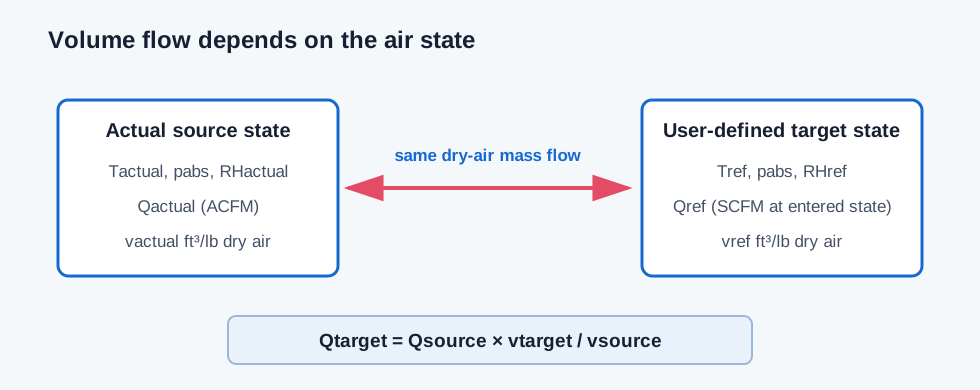
The ACFM to SCFM Calculator does not choose a universal reference state. It asks you to enter the actual and reference states, name the source for the reference, and confirm that the entered conditions match it. Its conversion preserves dry-air mass flow using moist-air specific volume per unit dry-air mass. It is not a correction for a particular airflow meter unless that meter method calls for this same model.
| Quantity | State or basis | What it does not mean by itself |
|---|---|---|
| ACFM | Actual temperature, total absolute pressure, and RH at the actual state | Not a standard volume or a mass flow |
| SCFM in this tool | User-entered reference temperature, total absolute pressure, and RH | Not a universal standard condition unless the named convention defines it |
| Dry-air mass flow | Mass of dry air per time, inferred from actual volume and dry-air specific volume | Not total moist-air mass when humidity ratio is nonzero |
| Total moist-air density | Total moist-air mass per actual mixture volume | Not interchangeable with dry-air mass per mixture volume |
Enter the source and target states
Select “Actual ACFM to reference SCFM” when the source flow is measured or calculated at the actual state. Select the reverse direction only when the entered source number is already on the reference basis. Enter source airflow as a positive finite CFM value.
For both actual and reference states, enter dry-bulb temperature in °F, total absolute barometric pressure in psia, and relative humidity from 0 to 100%. The converter supports −40 to 140°F. Enter absolute pressure, not gauge pressure, duct static pressure, or fan pressure. No elevation, weather, or local station-pressure lookup is performed.
Describe the source that establishes all three reference conditions, then confirm them. The source note is traceability supplied by the user; the calculator cannot authenticate the document or determine which convention applies to a project.
- Actual state: temperature, total absolute barometric pressure, and relative humidity for the ACFM measurement or calculation.
- Reference state: the exact temperature, absolute pressure, and humidity condition required by the named convention.
- The entered vapor pressure must remain below total absolute pressure for each state. Invalid or non-finite states are rejected.
Formula and variables
For each state, the model calculates water-vapor partial pressure from relative humidity and saturation pressure, then computes humidity ratio W and specific volume v on a dry-air mass basis. The airflow conversion follows from conserving that dry-air mass between the two expressions of volume flow.
Specific volume v is cubic feet of moist-air mixture per pound of dry air. Because W may differ between states, this formulation conserves dry-air mass rather than total moist-air mass. The result is a psychrometric engineering approximation using the stated perfect-gas relations; it is not a real-gas correction or meter calibration factor.
pv = (RH / 100) × pws(T)
W = 0.621945 × pv / (pabs − pv)
v = 0.370486 × (T°F + 459.67) × (1 + 1.607858W) / pabs[psia]
Qtarget = Qsource × vtarget / vsource
mdry-air = 60 × Qsource / vsource
| Symbol | Meaning | Unit or basis |
|---|---|---|
| pv | Water-vapor partial pressure | psia after conversion from psychrometric pressure units |
| pws(T) | Saturation vapor pressure at dry-bulb temperature | Same pressure units as pv |
| W | Humidity ratio | lb water / lb dry air |
| v | Moist-air specific volume per dry-air mass | ft³ / lb dry air |
| Qsource, Qtarget | Volume flow at source and target states | CFM at the named state |
| mdry-air | Dry-air mass flow | lb dry air / h |
| pabs | Total absolute barometric pressure | psia; not gauge or duct pressure |
Independent worked conversion
Use the constructed example shown in the calculator: 1,000 ACFM at 95°F, 14.2 psia, and 40% RH. Convert to a user-defined reference of 70°F, 14.696 psia, and 0% RH. These are example inputs, not a universal SCFM convention.
Using the ASHRAE psychrometric specific-volume relation at those entered states gives vactual = 14.8122278832 ft³/lb dry air and vreference = 13.3529749333 ft³/lb dry air. Independently apply the mass-conservation ratio: Qreference = 1,000 × 13.3529749333 / 14.8122278832 = 901.4832 SCFM. Dry-air mass flow is 60 × 1,000 / 14.8122278832 = 4,050.707 lb dry air/h. Rounded to three decimals, the converted value is 901.483 SCFM at the explicitly entered reference; the calculator mode example reports 901.483 SCFM.
As a reverse check, 901.4832230913 × 14.8122278832 / 13.3529749333 = 1,000.000 ACFM within rounding. The output unit and reference-state note should travel together; “SCFM” alone is not enough to reconstruct the conversion.
Qref = 1,000 × (13.3529749333 / 14.8122278832) = 901.4832 SCFM
| Item | Value | Basis |
|---|---|---|
| Source flow | 1,000 ACFM | 95°F, 14.2 psia, 40% RH |
| Reference state | 70°F, 14.696 psia, 0% RH | User-defined example basis |
| Actual specific volume | 14.8122278832 ft³/lb dry air | ASHRAE perfect-gas moist-air relation |
| Reference specific volume | 13.3529749333 ft³/lb dry air | ASHRAE perfect-gas moist-air relation |
| Independent conversion | 901.4832 SCFM | Rounded to 901.483 SCFM |
| Calculator example | 901.483 SCFM | Same entered reference conditions |
| Dry-air mass flow | 4,050.707 lb dry air/h | 60 × source CFM / actual specific volume |
Interpret the result and select a downstream basis
The converted airflow is the volume flow at the target psychrometric state that represents the same dry-air mass flow under the model. It is not automatically a fan operating point, a duct-sizing flow, a total moist-air mass flow, or a pressure basis. Before using it in another calculation, verify that the downstream method expects airflow at that same state.
The separate Air Density Calculator reports total moist-air density, dry-air mass per mixture volume, and specific volume per dry-air mass. Choose the property that matches the mass basis of the next equation. Do not multiply an actual CFM value by a density on a different state without an explicit conversion.
| Next task | Confirm before transferring the number |
|---|---|
| Fan performance comparison | Actual inlet volume flow and matching inlet density at the same duty point |
| Duct traverse comparison | Actual CFM at the traverse density, or a separately documented conversion |
| Product curve lookup | Whether the catalog curve uses ACFM, SCFM, a stated reference state, or a face-velocity coordinate |
| Mass balance | Whether each flow is actual volume at its own state or already converted to a compatible mass basis |
Conclusion and limitations
ACFM describes volume at actual conditions. SCFM describes volume at a reference state that must be named. The calculator uses the two states to compare dry-air specific volumes, preserves dry-air mass flow, and displays the resulting volume at the target state.
The method assumes ordinary moist air and perfect-gas psychrometric relations over the implemented temperature range. It does not handle real-gas behavior, contaminants, non-air gas mixtures, compressibility-meter factors, instrument calibration, or field certification. Keep the reference-condition source with the result and do not infer local code or equipment requirements from the converted number.
FAQs
Is SCFM one universal reference condition? No. State the reference temperature, absolute pressure, humidity convention, and source before comparing SCFM values.
Can I use the converted flow directly on any fan curve? Only when the curve uses the same airflow basis and pressure/density condition.
Does the conversion measure the airflow? No. It converts the entered states under the moist-air model; instrument calibration and field uncertainty remain separate.