
NC and dBA are different summaries
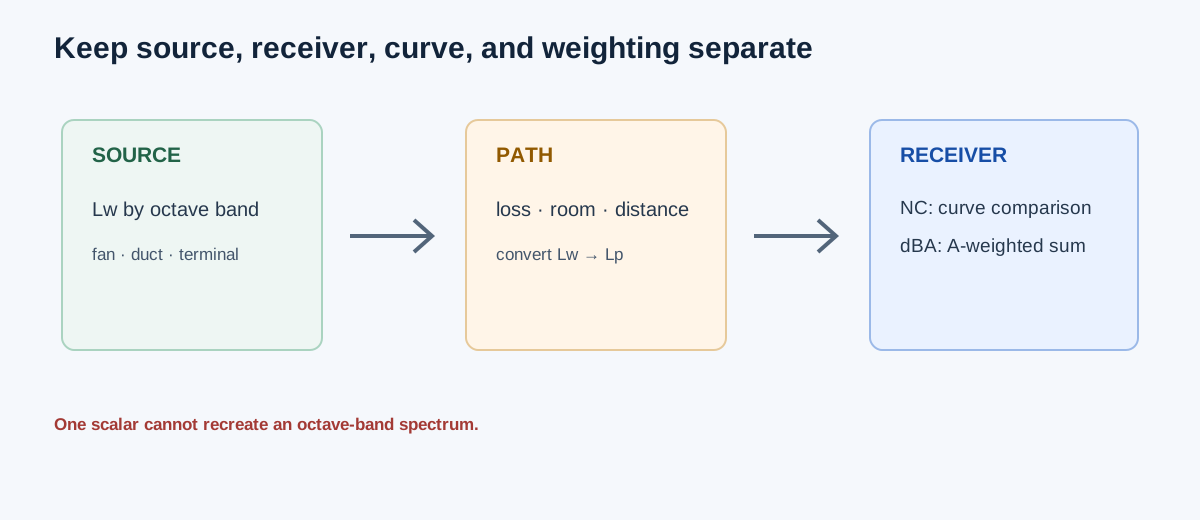
Noise Criteria (NC) compares an eight-band unweighted octave-band sound-pressure spectrum with a named curve family. dBA applies frequency weighting to band levels and combines weighted energy into one A-weighted level. Sound power Lw describes a source boundary; sound pressure Lp describes a receiver boundary.
A scalar dBA value cannot recreate an octave spectrum, and an NC result cannot be calculated from sound power without a compatible path and receiver model. The calculator requires the complete 63–8,000 Hz receiver spectrum for the NC comparison.
| Quantity | Basis | Use |
|---|---|---|
| Sound power Lw | Source energy by band | Propagate through a compatible path |
| Sound pressure Lp | Receiver level by band | Compare with NC or calculate dBA |
| NC | Unweighted eight-band receiver spectrum | Find containing curve and controlling bands |
| dBA | A-weighted band energy sum | Report one weighted receiver level |
Enter a complete receiver spectrum
For NC, confirm the receiver and spectrum reference, enter all eight unweighted octave-band levels, and optionally enter a selected target curve. The implementation checks the lowest tabulated NC curve containing every supplied band, retains tied controlling frequencies, and keeps a discretionary interpolation estimate separate from the tabulated rating.
For dBA, use the octave-band dBA calculator with the complete supported bands and a consistent mean-square pressure basis. Do not enter an overall dBA result as if it were one band, and do not mix sound power with receiver pressure.
| Step | Action | Reason |
|---|---|---|
| 1 | Define receiver and measurement basis | Keeps Lp and Lw distinct |
| 2 | Enter all supported octave bands | A missing band can change NC or dBA |
| 3 | Choose target only if needed | Target margins are user-selected criteria |
| 4 | Review controlling bands and weighting | Frequency shape matters, not only the scalar |
Independent NC example
Use the exact NC 15 spectrum: 63–8,000 Hz levels 47, 36, 29, 22, 17, 14, 12, and 11 dB. Each supplied level equals the corresponding NC 15 curve limit, so the lowest containing tabulated curve is NC 15, the interpolation estimate is 15, and every target margin is zero.
This does not say the room sounds acceptable. It says the supplied eight-band receiver spectrum lies on the selected traditional curve family under the entered reference. Measurement quality, background, tonal character, room use, and current project criteria remain separate.
For each band f: Lp(f) ≤ NC_N(f)
NC 15 spectrum = [47, 36, 29, 22, 17, 14, 12, 11] dB
Target margin(f) = NC15(f) − Lp(f) = 0 dB at every band
| Result | Independent value | Calculator display |
|---|---|---|
| Lowest containing curve | NC 15 | NC 15 (tabulated) |
| Controlling bands | All eight bands | All eight bands |
| Interpolation estimate | 15 | 15 |
| Minimum target margin | 0 dB | 0 dB |
Interpret dBA without losing the spectrum
A-weighting applies a band correction before energy summation. Two spectra can have the same dBA while having different low-frequency content and different NC behavior. Preserve the band levels and weighting corrections alongside any scalar result.
When a source path is involved, first convert or propagate compatible source power to receiver pressure by band. Then apply NC or dBA at the receiver. Do not subtract dB values directly when combining independent uncorrelated sources; combine energy by band before applying a final summary.
| Finding | Next check |
|---|---|
| NC passes | Review low-frequency, tonal, background, and measurement limits |
| dBA is acceptable | Inspect octave spectrum and NC or project criterion |
| Lw is supplied | Build a compatible path to receiver Lp |
| Band missing | Obtain the band or withhold the complete rating |
FAQs
Is NC 25 equal to 25 dBA? No. NC is a curve-family comparison; dBA is an A-weighted energy sum. Can sound power be compared directly with NC? No. NC expects receiver pressure levels. Does the lowest containing curve diagnose the source? No; it summarizes the entered receiver spectrum.
The calculator does not model room transfer, directionality, correlated tones, breakout, terminal self-noise, background aggregation, or current-code compliance. Those need compatible path and project data.
Conclusion and limits
Use complete octave-band receiver data, preserve the distinction between Lw and Lp, and report NC and dBA as different summaries. A scalar result should remain attached to its spectrum and measurement basis.
The cited NC tables and weighting method support the implemented arithmetic. They do not establish a universal room criterion, field measurement validity, or complete acoustic compliance result.