
Speed geometry answers only the kinematic part
A belt drive connects driver and driven shaft speed through the pitch diameters and any selected slip. Tip speed is the peripheral speed at the impeller outside diameter. These calculations help check a proposed speed change, but they do not select a belt, certify a sheave, or prove that the fan can safely or efficiently operate at the result.
Keep motor RPM, driver sheave pitch diameter, driven sheave pitch diameter, fan shaft RPM, impeller diameter, and tip speed distinct. A motor’s electrical synchronous speed is not automatically its loaded shaft speed, and a duct diameter is not an impeller diameter.
| Quantity | Meaning | Use |
|---|---|---|
| Driver shaft RPM | Speed entering the sheave | Input to belt ratio |
| Pitch diameter | Diameter at the belt pitch line | Speed and belt-length geometry |
| Fan shaft RPM | Driven impeller shaft speed | Tip-speed calculation and fan curve check |
| Impeller outside diameter | Actual rotating outside diameter | Peripheral tip speed |
| Tip speed | Peripheral velocity at the outside diameter | Kinematic screening only |
Enter the correct mode and physical inputs
For a belt-drive check, enter measured or rated driver shaft RPM, matching pitch diameters, shaft center distance, and an explicit slip percentage. The calculator rejects overlapping sheaves. Its open-belt length is an approximation and its smaller-sheave wrap is a geometric angle.
For tip speed, choose the known-diameter/known-RPM mode, or solve for shaft RPM from diameter and target tip speed, or solve for diameter from shaft RPM and target tip speed. Enter the actual impeller outside diameter in inches and fan shaft RPM. The result is reported in FPM, ft/s, and m/s.
| Mode | Inputs | Output |
|---|---|---|
| Belt drive | Driver RPM, driver/driven pitch diameters, center distance, slip | Fan RPM, approximate belt pitch length, wrap angle |
| Known tip speed | Impeller diameter and fan shaft RPM | Tip speed in FPM, ft/s, and m/s |
| Solve RPM | Impeller diameter and target tip speed | Required fan shaft RPM |
| Solve diameter | Fan shaft RPM and target tip speed | Impeller outside diameter |
Independent belt-drive example
Use a 1,750 RPM driver, 4 in driver pitch diameter, 8 in driven pitch diameter, 20 in center distance, and 2% slip. The fan speed is 1,750 × 4/8 × (1−0.02) = 857.5 RPM. The open-belt approximation gives L = 2C + π(D+d)/2 + (D−d)²/(4C) = 59.049556 in. The smaller-sheave wrap is 180° − 2 asin((D−d)/(2C)) = 168.521659°.
The calculator displays 857.5 RPM, 59.0496 in, and 168.5217°. These numbers describe the entered pitch geometry. Select the actual belt section, sheaves, tension, alignment, guard, service factor, and allowable speed from matching manufacturer data.
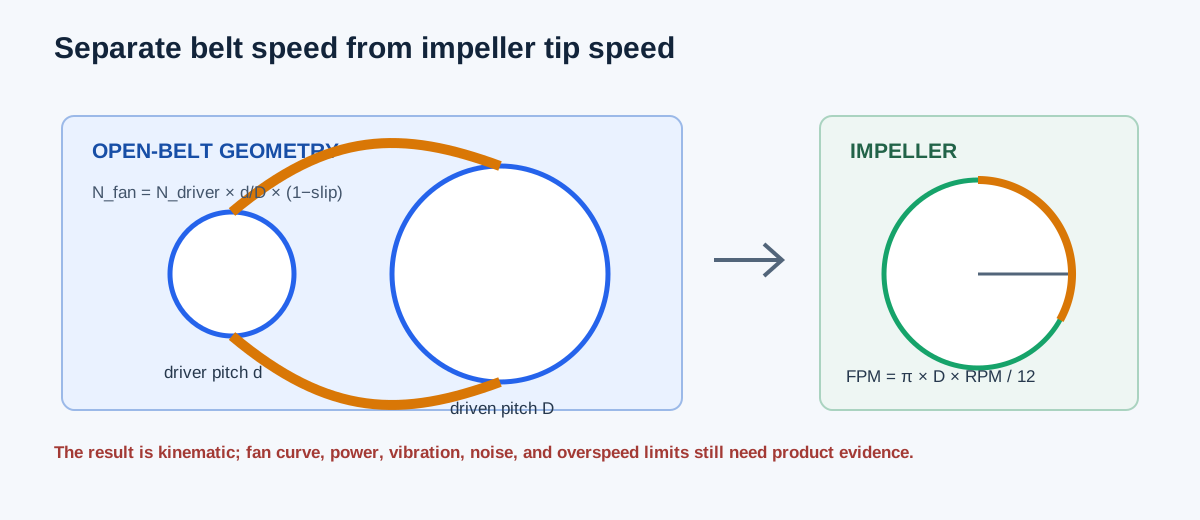
N_fan = N_driver × D_driver/D_driven × (1−slip)
= 1,750 × 4/8 × 0.98 = 857.5 RPM
L ≈ 2(20) + π(4+8)/2 + (8−4)²/(4×20) = 59.049556 in
Wrap = 180° − 2 asin(4/(40)) = 168.521659°
| Result | Independent value | Calculator display |
|---|---|---|
| Driven fan speed | 857.5 RPM | 857.5 RPM |
| Approximate pitch length | 59.049556 in | 59.0496 in |
| Smaller-sheave wrap | 168.521659° | 168.5217° |
Independent tip-speed example
For a 12 in impeller at 1,750 fan shaft RPM, tip speed is π × 12 × 1,750 / 12 = 5,497.787144 FPM. Dividing by 60 gives 91.629786 ft/s; multiplying FPM by 0.00508 gives 27.928759 m/s. The calculator displays 5,497.787 FPM, 91.630 ft/s, and 27.929 m/s.
The inverse modes use the same relation. A 12 in impeller at a target 4,000 FPM requires 4,000 × 12/(π × 12) = 1,273.239545 RPM. A 6,000 FPM target at 3,000 RPM requires an outside diameter of 6,000 × 12/(π × 3,000) = 7.639437 in.
Tip speed = π × D × RPM / 12
= π × 12 × 1,750 / 12 = 5,497.787144 FPM
RPM for 4,000 FPM at 12 in = 4,000 × 12/(π × 12) = 1,273.239545 RPM
D for 6,000 FPM at 3,000 RPM = 6,000 × 12/(π × 3,000) = 7.639437 in
| Question | Independent value | Calculator display |
|---|---|---|
| 12 in at 1,750 RPM | 5,497.787 FPM | 5,497.787 FPM |
| Peripheral velocity | 91.630 ft/s; 27.929 m/s | 91.630 ft/s; 27.929 m/s |
| RPM for 12 in and 4,000 FPM | 1,273.240 RPM | 1,273.240 RPM |
| Diameter for 3,000 RPM and 6,000 FPM | 7.639437 in | 7.639 in |
Check the actual fan after the speed calculation
A new RPM changes the fan operating point and mechanical duty. Check the exact fan curve, system curve, density, motor and drive capacity, shaft power, bearing and belt limits, vibration, noise, impeller integrity, overspeed restrictions, and guard clearance. If the belt ratio changes, the fan may no longer operate at the point assumed by a previous pressure or airflow estimate.
Tip speed can be useful for comparing similar configurations, but the calculator does not supply a universal safe tip-speed limit. Product-specific limits, blade construction, temperature, balance quality, resonance, and control behavior require their own evidence.
| Check | Why it matters |
|---|---|
| Pitch data | Outside diameter is not pitch diameter |
| Slip and loaded RPM | The actual fan speed can differ from the ideal ratio |
| Fan curve and system curve | Speed geometry does not determine delivered airflow |
| Power and motor | Fan laws and belt geometry do not prove motor capacity |
| Balance, vibration, and guard | Mechanical safety and installation conditions remain separate |
FAQs
Can I use motor RPM as fan RPM? Only when the drive relationship and slip support it. A belt, pulley, gearbox, or VFD can make fan shaft speed different.
Does a larger driven sheave always make the fan faster? No. With an open belt and the same driver, a larger driven pitch diameter lowers the driven speed.
Does tip speed predict noise or efficiency? No. It is a peripheral velocity calculation. Noise, aerodynamic loading, efficiency, and structural limits require matching fan data.
Is the approximate belt length a belt selection? No. Confirm belt section, catalog pitch length, tension, wrap, alignment, service factor, and guard requirements.
Conclusion and limits
Use the belt mode to check the speed relationship and geometric wrap, then use the tip-speed mode with the actual impeller diameter and fan shaft RPM. Treat the result as a kinematic input to the broader fan, drive, vibration, and system checks.
The calculator and cited fan guidance support the displayed equations and boundaries. They do not provide a universal overspeed, tip-speed, belt, motor, noise, or structural approval.