
Two meanings of equivalent
An equal-area conversion preserves the cross-sectional area of the clear air passage. At the same volumetric flow, this also preserves average area velocity. An equal-friction conversion instead uses a named empirical equivalent-round relationship intended to match straight-duct friction per unit length at equal airflow. The converted section will generally have a different area and velocity.
Neither conversion is the same as hydraulic diameter, and none of the three is a complete system pressure calculation. The duct-shape calculator includes round, rectangular, and flat-oval modes; in its flat-oval geometry, the long dimension contains two straight sides joined by semicircular ends. It is not an ellipse.
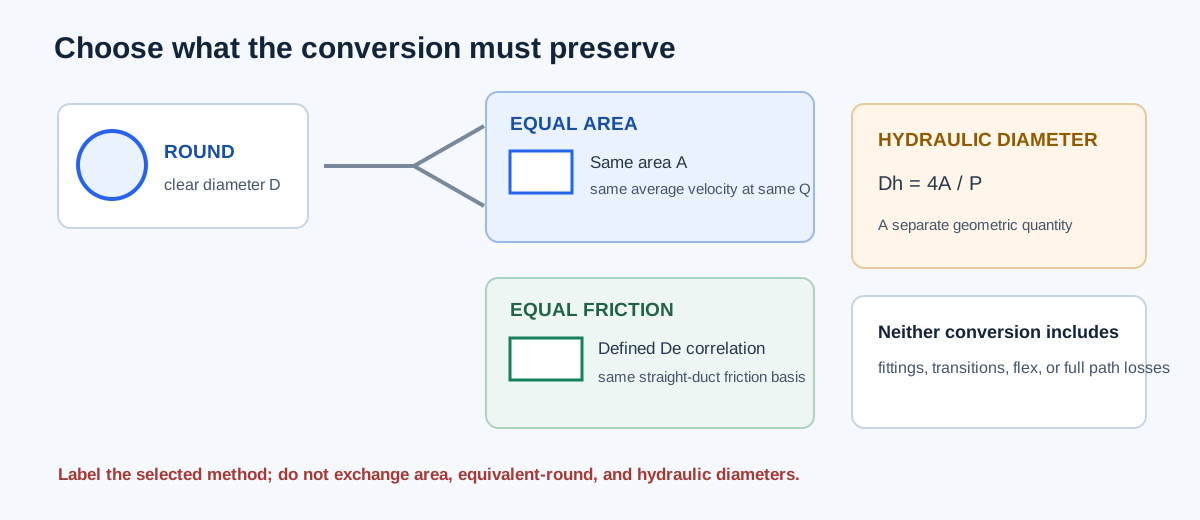
| Quantity | Definition in this workflow | What it does not establish |
|---|---|---|
| Equal-area round diameter | Circle with the same clear cross-sectional area | Equal straight-duct friction |
| Equal-friction round diameter | Round reference under the selected ASHRAE equivalent-round correlation | Actual hydraulic diameter or full path loss |
| Hydraulic diameter | 4 × area ÷ wetted perimeter | An interchangeable equal-friction correlation |
Choose a mode and enter clear dimensions
Select round-to-rectangle, rectangle-to-round, round-to-flat-oval, or flat-oval-to-round and choose equal area or equal friction where the interface provides both. Enter the inside round diameter or clear width and height in inches. The round-to-rectangle modes also need a selected width-to-height ratio; round-to-flat-oval modes need a fixed inside minor axis. Keep dimensions clear of liner and sheet thickness.
The result updates from the entered geometry. Check the displayed equal-area diameter, equal-friction diameter, area, perimeter, and hydraulic diameter together. If dimensions are used for layout, also check the actual installed envelope, transition length, fittings, velocity, and a separate pressure budget. The tool returns theoretical geometry, not a nominal size or fabrication drawing.
| Step | Input or action | Review |
|---|---|---|
| 1 | Choose conversion direction and equal-area/equal-friction basis | The basis determines what is held equivalent |
| 2 | Enter inside diameter or clear width and height | Exclude liner and wall thickness from clear dimensions |
| 3 | Enter aspect ratio or fixed flat-oval minor axis when requested | Major axis must be at least the minor axis |
| 4 | Read both equivalent diameters and geometry outputs | Do not label hydraulic diameter as an equal-friction result |
| 5 | Review the connected installation | Recheck velocity, transition, fittings, envelope, and path pressure |
Independent 10-inch round area example
For a 10 in inside round duct, area is A = πD²/4 = π(10²)/4 = 78.5398 in². If the rectangular target ratio is W:H = 2:1, set WH = A and W/H = 2. Solving gives W = √(2A) = 12.5331 in and H = W/2 = 6.2666 in. Both sections therefore have the same calculated area, 78.5398 in², and the same average velocity at a common CFM.
The calculator reports approximately 12.5 × 6.3 in at its display precision. That result does not demonstrate equal friction. For a distinct comparison, the calculator’s documented 18 × 12 in flat-oval example has an independently computed area diameter of 15.3517 in and an ASHRAE equal-friction diameter of 15.2535 in. The two outputs differ because their definitions differ.
Round area: A = πD²/4
Equal-area rectangle: WH = A; W/H = r
W = √(Ar); H = √(A/r)
Rectangular equal-friction: De = 1.30(WH)^0.625/(W+H)^0.25
Flat-oval equal-friction: De = 1.55A^0.625/P^0.25
| Case | Independent calculation | Calculator display |
|---|---|---|
| 10 in round to 2:1 equal-area rectangle | 78.5398 in²; 12.5331 × 6.2666 in | About 12.5 × 6.3 in |
| 18 × 12 in flat oval, equal-area diameter | 15.3517 in | 15.352 in |
| 18 × 12 in flat oval, equal-friction diameter | 15.2535 in | 15.254 in |
Use equal-friction conversions within their method
The rectangular relationship in this workflow is ASHRAE Chapter 21 Equation 25. The flat-oval relationship is Equation 26 and uses the defined flat-oval area and perimeter. ASHRAE Table 9 includes a 28 × 14 in flat-oval example: A = 349.9380 in² and P = 71.9823 in produce De ≈ 20.7024 in, which rounds to the listed 20.7 in. The corresponding hydraulic diameter is 4A/P ≈ 19.4458 in, not 20.7 in.
These correlations are straight-duct equivalence relationships under the stated basis. They do not model flexible-duct compression, fittings, transitions, changed roughness, leakage, or a complete route. Use the converted dimensions as an input to later checks, not as a substitute for them.
For a flat oval with major axis a and minor axis b:
A = πb²/4 + b(a−b)
P = πb + 2(a−b)
De = 1.55A^0.625/P^0.25
Dh = 4A/P
| 28 × 14 in flat oval | Value | Basis |
|---|---|---|
| Area | 349.9380 in² | Semicircular ends plus straight-sided portion |
| Wetted perimeter | 71.9823 in | Flat-oval perimeter |
| Equal-friction diameter | 20.7024 in | ASHRAE Equation 26; Table 9 rounds to 20.7 in |
| Hydraulic diameter | 19.4458 in | 4A/P; separate quantity |
FAQs
Does equal area mean equal pressure loss? No. It means the same clear area; use the selected equivalent-round correlation when the task is straight-duct friction equivalence.
Can hydraulic diameter replace the ASHRAE equivalent diameter? No. They use different definitions and can return different values for a noncircular section. Keep the requested calculation method with the result.
Does a theoretical conversion select a product? No. Confirm clear and outside dimensions, available sizes, transition geometry, actual airflow, friction, fittings, and project clearance separately. No nominal rounding or supplier availability is inferred.
Conclusion and limits
Choose equal area when preserving open area is the decision. Choose equal friction only when the named straight-duct method and its conditions are appropriate. Report the selected basis and retain equal-area, equal-friction, and hydraulic diameters as separate results.
The ASHRAE 2025 Handbook equations and Table 9 provide the correlation basis used by the existing calculator. Product availability, installed construction, fitting losses, and complete system performance require separate evidence.