
Use a separate takeoff for each product quantity
A straight-duct sheet estimate, insulation wrap estimate, and sealant order each use different geometry and product data. The metal estimator calculates straight-wall area, mass, and an optional cost from actual dimensions, thickness, density, allowance, and a user price. The wrap estimator adds a manufacturer stretch-out allowance and waste before converting area to whole rolls. The sealant estimator uses measured seam length and product coverage at the specified application to estimate gallons and packages.
None of these outputs is a complete bill of materials. Fittings, transitions, ends, flanges, reinforcement, supports, facing, joints, labor, tax, delivery, field waste, and installation requirements need separate review unless explicitly included in a user-entered allowance. The tools do not select products, infer material from gauge, prescribe coverage, or supply market prices.
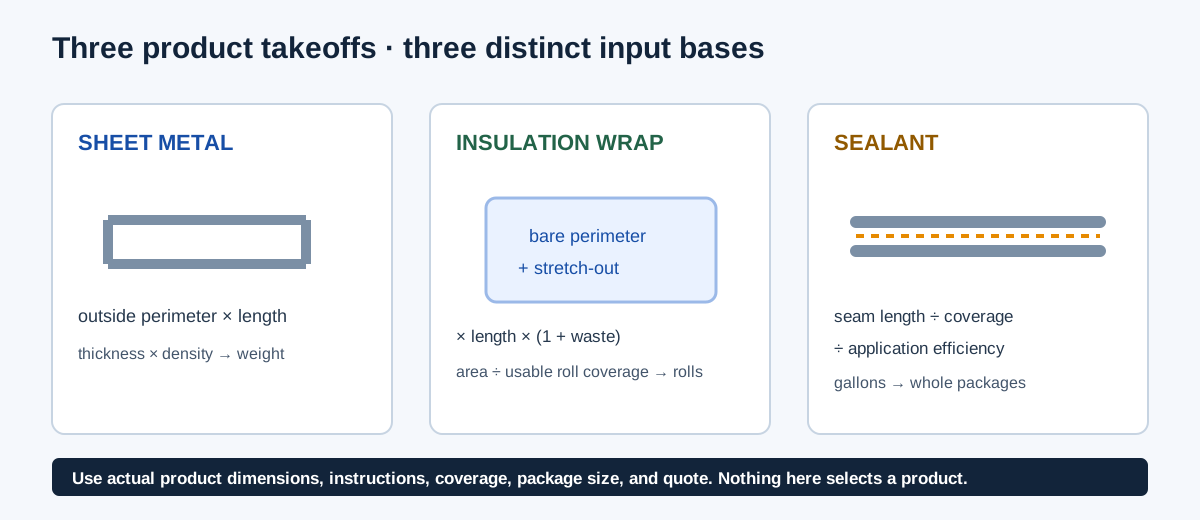
| Takeoff | Measured or supplied basis | Output |
|---|---|---|
| Metal | Outside dimensions, straight length, thickness, material density | Bare area, allowance area, estimated weight, user-price cost |
| Wrap | Bare duct outside perimeter, length, product stretch-out, waste, roll coverage | Net/purchased area and whole roll count |
| Sealant | Seam length, product coverage, application efficiency, package size | Required gallons, whole packages, ordered volume, user-price cost |
Collect the correct inputs for each product
Use exterior sheet geometry for straight duct material calculations. For round sections, enter the outside metal diameter; for rectangular sections, enter outside width and height on the same basis. The insulation wrap method instead uses bare duct outside perimeter plus a product-specific stretch-out. Sealant quantity starts from the seams that will receive that exact product.
- Metal: select round or rectangular, enter outside dimensions in inches and total straight length in feet, then enter actual metal thickness in inches and material density in lb/ft³.
- Metal allowance: enter an explicit percent once. Gauge is not a thickness input and is not inferred. Enter a dated supplier price per pound only when you want a material-only cost.
- Wrap: choose single uniform run or row schedule. Enter bare outside dimensions, run length, manufacturer stretch-out, waste percent, and usable roll coverage.
- Wrap schedule: each row can have its own length, stretch-out, waste, and roll coverage. Whole rolls are rounded up per row; leftover pooling between rows is not calculated.
- Sealant: measure only seams that receive the product, then use ft/US gal coverage for the actual seam/application, an explicit utilization efficiency, actual usable gallons per package, and your package quote.
| Input | Use | Do not assume |
|---|---|---|
| Thickness and density | Actual material product data | Gauge-to-thickness conversion or universal steel/aluminum density |
| Stretch-out | Manufacturer add-on to bare perimeter | Extra overlap already included in product stretch-out |
| Waste / allowance | Explicit project or fabrication quantity | A standard percentage or duplicate waste factor |
| Coverage and efficiency | Product instructions at the actual application | Generic sealant or insulation coverage |
| Price | User’s dated supplier quote | Current regional or installed market price |
Formulas and unit conversions
For metal, the calculator estimates only straight exterior sheet area. Convert inches to feet before multiplying by length. Convert sheet thickness from inches to feet before multiplying area by thickness and density. The allowance is applied once to sheet area and weight; the material price is applied to the resulting weight.
For wrap, perimeter and stretch-out are in inches, so their sum is divided by 12 to obtain cut width in feet. Multiply by run length for net area, apply the entered waste fraction, divide by usable roll coverage, then round each roll count up to a whole roll.
For sealant, coverage is feet of seam per US gallon at a specified product/application. Application efficiency is entered as a percentage and converted to a fraction. The required quantity is divided by package gallons and rounded upward for ordering.
Metal round: Abare = πD L / 12; rectangular: Abare = 2(W + H)L / 12
Aallowance = Abare × (1 + allowance/100)
Weight = Aallowance × (thickness/12) × density
Wrap: net ft² = [(P + stretch-out)/12] × L; purchased area = net × (1 + waste/100)
Rolls = ceil(purchased area / usable coverage)
Sealant gallons = seam length / [coverage × (efficiency/100)]; packages = ceil(gallons/package gallons)
| Symbol/input | Meaning | Unit |
|---|---|---|
| D, W, H | Outside round diameter or rectangular dimensions | in |
| L | Straight duct or seam length | ft |
| t | Actual metal sheet thickness | in, converted to ft |
| ρmetal | Material mass density | lb/ft³ |
| P | Bare duct exterior perimeter | in |
| S | Product stretch-out add-on | in |
| Coverage | Seam length per US gallon or usable roll area | ft/US gal or ft²/roll |
| Efficiency | Application utilization fraction | % |
Independent metal area, weight, and cost example
Use a constructed round straight-duct takeoff: outside diameter 12 in, length 10 ft, actual sheet thickness 0.030 in, density 490 lb/ft³, zero allowance, and a user-entered price of $2/lb. Outside diameter is 1 ft, so bare area = π × 1 × 10 = 31.415927 ft². Thickness = 0.030/12 = 0.0025 ft. Weight = 31.415927 × 0.0025 × 490 = 38.484510 lb. Cost = 38.484510 × $2 = $76.969, or $76.97 to cents.
This independently reproduces the calculator example. Adding a 10% user allowance would produce 34.557519 ft² and 42.332961 lb. The allowance changes quantity; it does not specify fabrication details or certify the sheet gauge, pressure class, reinforcement, or structural support.
Abare = π × (12/12) × 10 = 31.415927 ft²
Weight = 31.415927 × (0.030/12) × 490 = 38.484510 lb
Cost = 38.484510 × $2/lb = $76.969 ≈ $76.97
| Quantity | Independent result | Calculator example |
|---|---|---|
| Bare sheet area | 31.415927 ft² | 31.415927 ft² |
| Metal weight at zero allowance | 38.484510 lb | 38.484510 lb |
| Material cost at $2/lb | $76.969, about $76.97 | $76.969 |
| Weight with 10% allowance | 42.332961 lb | 42.332961 lb |
Independent wrap and sealant order examples
Wrap example: rectangular bare duct is 18 × 12 in and 100 ft long. Use a constructed manufacturer stretch-out of 5 in, entered waste of 10%, and usable coverage of 100 ft² per roll. Bare perimeter = 2(18 + 12) = 60 in; cut width = 60 + 5 = 65 in. Net area = 65/12 × 100 = 541.6667 ft². Purchased area = 541.6667 × 1.10 = 595.8333 ft², so 595.8333/100 = 5.9583 rolls and the order rounds up to 6 rolls.
Sealant example: use 1,200 ft of seams, user-supplied product coverage of 45 ft/US gal at the specified application, 85% application efficiency, 5 US gal of usable product per package, and a user quote of $80 per package. Required = 1,200/(45 × 0.85) = 31.372549 US gal. Whole packages = ceil(31.372549/5) = 7; ordered volume is 35 US gal and material cost under that quote is 7 × $80 = $560. These are constructed arithmetic inputs, not product coverage recommendations.
Wrap: 2(18+12)=60 in; cut width=60+5=65 in
Net=65/12×100=541.6667 ft²; purchased=541.6667×1.10=595.8333 ft²; rolls=ceil(595.8333/100)=6
Sealant: 1,200/(45×0.85)=31.372549 gal; packages=ceil(31.372549/5)=7; order=35 gal; cost=7×$80=$560
| Method | Inputs | Independent result | Calculator example |
|---|---|---|---|
| Wrap | 18 × 12 in; 100 ft; 5 in stretch-out; 10% waste; 100 ft²/roll | 595.8333 ft²; 6 rolls | 6 rolls; same net/purchased area |
| Sealant | 1,200 ft; 45 ft/gal; 85%; 5 gal/package; $80/package | 31.372549 gal; 7 packages; 35 gal; $560 | Same quantity and entered-quote cost |
Interpret the takeoff before ordering
Metal weight is a geometric estimate for straight walls and the actual entered thickness/density. Wrap area includes the explicit product stretch-out and waste; a schedule rounds rolls per row and does not pool leftovers. Sealant packages round up after estimated use, so ordered volume can exceed modeled consumption. These outputs cannot establish a preferred product or whether an installation meets a seal class or thermal requirement.
Before purchasing, reconcile fittings, transitions, end caps, joints, flanges, supports, access openings, reinforcement, facing, delivery, labor, taxes, storage, substrate conditions, installation temperature, cure requirements, and inspection criteria against actual shop drawings and product submittals.
| Difference | Possible cause | Next check |
|---|---|---|
| Sheet area/weight | Fittings, seams, reinforcement, nested cuts, thickness tolerance | Fabrication drawings and actual takeoff policy |
| Wrap rolls | Product overlap, cut pattern, offcuts, package coverage, multiple sizes | Manufacturer installation table and row-level schedule |
| Sealant packages | Bead size, wet thickness, substrate, transfer loss, package residue | Exact product instructions and application conditions |
| Cost | Freight, tax, labor, quote date, market changes | Current supplier quotation and commercial terms |
Conclusion and limits
The quantity formulas are straightforward when the measured geometry and product basis are explicit. Keep metal, wrap, and sealant estimates separate; use actual product data for thickness, density, stretch-out, coverage, efficiency, package contents, and price. Treat the calculator as a preliminary quantity tool, then reconcile the result against the complete design and product documentation.
The metal estimator uses geometric relationships and does not adopt a gauge table. Wrap and sealant coverage remain user-supplied product values; no universal waste rate, coverage, current price, or code-compliance claim is provided.
FAQs
Does the takeoff select gauge or reinforcement? No. It calculates the entered geometry, thickness, density, coverage, allowance, and price.
Can unused wrap or sealant be pooled across rows? The schedule rounds each row according to its entered coverage and package rule; review actual procurement separately.
Does the quantity prove a seal class or thermal performance? No. Product selection, application, seams, and installation remain separate.